Does Energy Healing Really Work? What 353 Studies Show

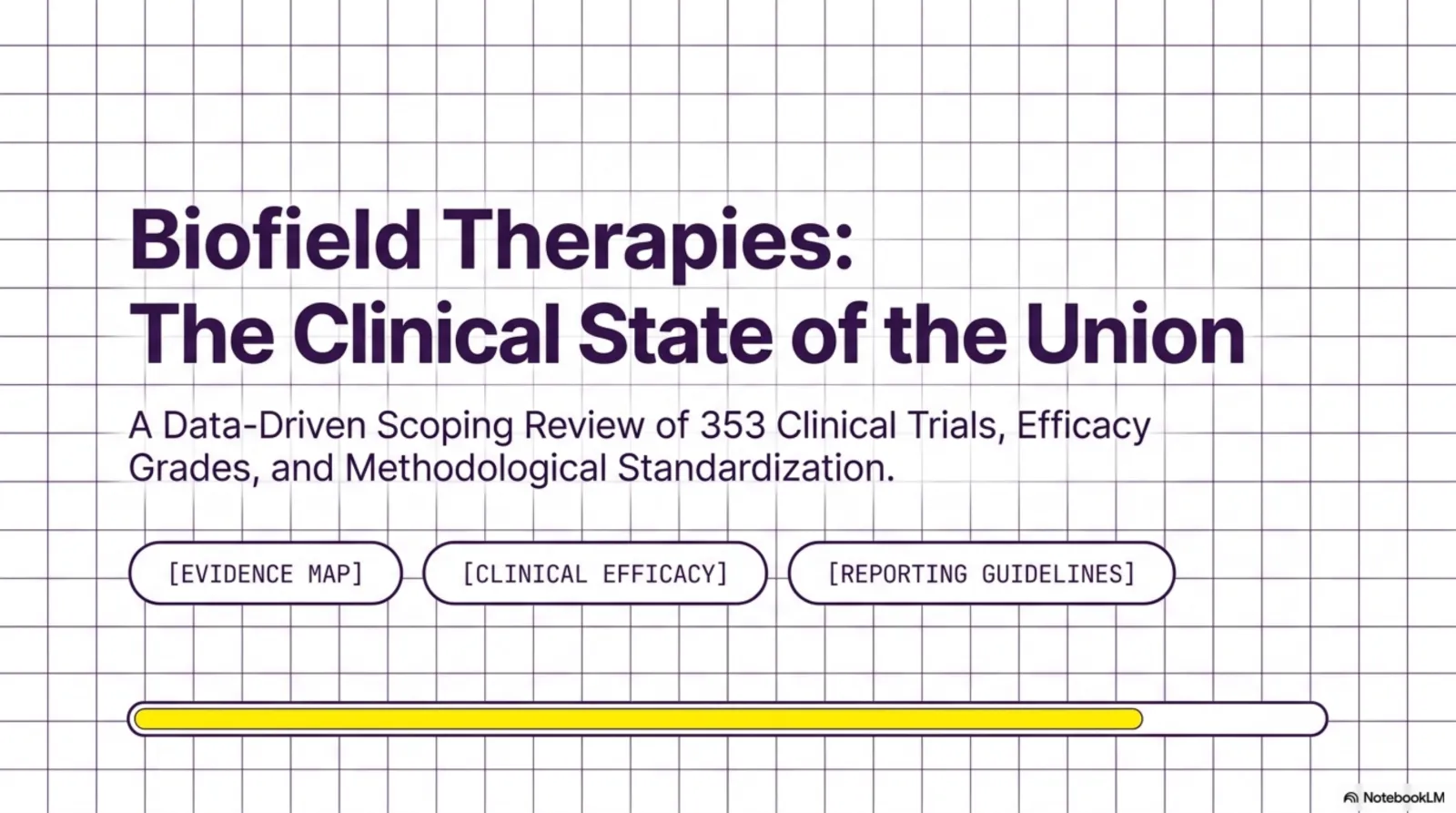
Yes, with caveats that matter. A 2025 Journal of Integrative and Complementary Medicine scoping review identified 353 biofield therapy studies, 255 of them randomised controlled trials. Effects on pain, anxiety, and quality of life are real and replicable. They are also moderate in size, smaller than first-line CBT or SSRIs, with low-to-very-low evidence quality ratings due to small samples and inconsistent methods. Major hospitals including Cleveland Clinic and OHSU offer Reiki and Healing Touch. The most accurate framing is "modest reliable benefit, particularly for symptom management alongside conventional care."
Key Questions Answered
Is there real evidence for energy healing?
Yes. The 2025 JICM scoping review identified 353 studies including 255 RCTs. NCCIH lists biofield therapies as having promising but limited evidence for chronic pain. A 2024 BMC Palliative Care meta-analysis covering 13 Reiki studies and 824 patients found significant impact on anxiety.
Why does the evidence quality keep getting flagged as low?
Most studies are small (n under 100). Blinding is hard for hands-on therapy. The placebo and therapeutic-relationship components are difficult to isolate from any energy-specific effect. The effect sizes that survive across studies and research teams are real but smaller than the strongest treatment claims.
Does it work better than placebo?
For some modalities, yes. The 2017 Baldwin Reiki RCT showed real Reiki produced respiration drop that sham Reiki did not match. The 2017 McManus Sage review concluded Reiki outperforms placebo on multiple measures. For other modalities the evidence is closer to the placebo effect, which is itself a real and measurable mechanism.
Why do major hospitals offer it if the evidence is mixed?
Because moderate reliable benefit at low cost and minimal risk is clinically useful. Cleveland Clinic, OHSU, Yale, Memorial Sloan Kettering, and others integrate Reiki and Healing Touch into oncology, palliative care, and pre-procedural anxiety reduction. The clinical bar for symptom support is different from the bar for primary disease treatment.
When should I expect it to work for me?
When the condition has a strong autonomic-arousal or stress-load component. When you want symptom relief alongside conventional treatment. When the alternative is no treatment, or treatment that has hit a ceiling. Less likely when the condition is structurally driven (active infection, fracture, severe organ dysfunction).
In This Guide
Key Takeaways
- A 2025 scoping review in the Journal of Integrative and Complementary Medicine identified 353 biofield therapy studies, including 255 randomised controlled trials.
- NCCIH classifies biofield therapies as having promising but limited evidence for chronic pain, with low-to-very-low certainty ratings due to methodological limitations.
- A 2024 BMC Palliative Care Reiki meta-analysis covered 13 studies and 824 patients, finding significant impact on anxiety, particularly for short-term protocols.
- The 2017 Baldwin pilot study showed real-Reiki recipients had measurable physiological changes that sham-Reiki controls did not match.
- Cleveland Clinic, OHSU, Yale, and Memorial Sloan Kettering integrate Reiki and Healing Touch into oncology and palliative care, reflecting clinical adoption ahead of definitive proof.
Listen to the deep-dive on this article
A two-host audio overview of the key ideas. Origins, mechanism, evidence, and what to expect. Useful when you would rather listen than read.
The Honest Answer
The most useful answer to "does energy healing really work" sits in three sentences. Yes, with moderate effect sizes that are smaller than first-line evidence-based treatment but reliably above zero. The evidence base is large but methodologically weaker than mainstream pharmaceutical or psychological therapies. Best use case is symptom management as a complement to conventional care, not replacement of it.
Almost nobody tells you this. The proponents oversell. The critics undersell. The truth requires reading the actual studies.
This article works through the actual evidence. The review papers. The trial designs. The mechanisms. The honest limits. By the end you will have a clearer picture than 95% of the conversations you will encounter on this topic.
What the 2025 Scoping Review Actually Found
The 2025 Journal of Integrative and Complementary Medicine scoping review on biofield therapies covered 353 studies. 255 of them were randomised controlled trials. The remainder were systematic reviews, meta-analyses, observational studies, and pilot trials.
The conditions covered include chronic pain (the largest cluster), anxiety, depression, cancer-related symptoms, fatigue, sleep quality, and procedural distress. The modalities covered were primarily Reiki, Healing Touch, Therapeutic Touch, External Qigong, and Johrei.
Across this set, the consistent findings were moderate effect sizes for pain reduction, moderate effects on anxiety, and improvements in subjective quality of life. The evidence quality was rated low to very low across most conditions, primarily because of small sample sizes, blinding limitations, and inconsistency between studies.
The reviewers concluded that biofield therapies show "promising effects on a wide range of clinical outcomes" while flagging that better-designed trials are needed for definitive conclusions. This framing matters. It is not "no evidence." It is "moderate evidence of a real but moderate effect, with the methodological work needed to firm up the confidence intervals."
The Strongest Individual Trials
Three studies stand out in the evidence base.
The 2017 Baldwin pilot at the Cleveland Clinic compared real Reiki, sham Reiki, and standard care after total knee replacement. Real Reiki recipients showed greater respiration rate reduction at 48 hours than either sham Reiki or standard care alone. The respiration rate dropped from 20.1 to 17.7 breaths per minute, a measurable physiological change that sham did not produce.
The 2017 McManus systematic review published in SAGE evaluated Reiki across multiple randomised controlled trials. Reiki produced significant improvement over placebo conditions on pain, anxiety, depression, and self-esteem outcomes. The review concluded that Reiki demonstrates effects beyond placebo on multiple measures.
The 2024 BMC Palliative Care meta-analysis covered 13 Reiki studies and 824 patients. Reiki produced significant impact on anxiety scores, with the effect strongest for short-term protocols (1 to 3 sessions) and procedural-anxiety contexts (gastrointestinal endoscopy, surgery, chemotherapy).
These are the strongest signals in the evidence base. They are real. They are moderate. They are not the strongest signals seen for first-line evidence-based treatment.
Why Major Hospitals Are Adopting It
The clinical adoption pattern is informative. Cleveland Clinic offers Reiki through its Center for Functional Medicine and integrates it into surgical recovery protocols. Oregon Health and Science University runs an integrative medicine clinic that delivers Reiki and Healing Touch. Yale, Memorial Sloan Kettering, Johns Hopkins, and many others have similar programmes.
The clinical reasoning is straightforward. Moderate reliable benefit at low cost and minimal risk is useful for symptom management. Patients with chronic pain, anxiety, post-surgical recovery, or chemotherapy-related fatigue often have residual symptoms that conventional treatment has not fully resolved. Adding a low-risk intervention with moderate evidence of benefit is a reasonable clinical decision.
The hospitals have not concluded that energy healing replaces conventional treatment. They have concluded that it earns a place alongside it for specific symptoms in specific patient populations.
Critics sometimes frame this adoption as "hospitals selling out to woo." A closer reading shows hospitals making evidence-based decisions about complementary care, with the energy healing services typically integrated into oncology, palliative care, and pre-procedural anxiety reduction.
What the Evidence Does Not Show
The evidence does not show that energy healing cures cancer, replaces antibiotics, eliminates the need for surgery, or treats severe mental illness. The evidence does not show effects on conditions where the underlying mechanism is structural, infectious, or severe biochemical dysfunction.
The evidence does not show that one modality is dramatically superior to another within the biofield category. Reiki, Healing Touch, Therapeutic Touch, and Johrei produce broadly similar effect sizes on similar conditions. The largest predictor of outcome is not which modality is used, it is whether the condition has an autonomic-arousal or stress-load component that responds to parasympathetic activation.
The evidence does not show that distance healing produces effects equivalent to in-person treatment. Some studies find effects, others find none. The methodological challenges with distance studies are larger than with in-person studies.
The evidence does not establish a specific physical mechanism for the effects. The autonomic regulation pathway is well documented. The "biofield" itself remains an explanatory model rather than a confirmed physical phenomenon. The effects can be real without the explanatory model being correct.
How to Evaluate a Practitioner Honestly
Several markers separate practitioners worth working with from practitioners worth avoiding.
Evidence-based framing. The good practitioners describe their work as complementary to conventional care. They mention the actual evidence base honestly, including its limitations. They do not promise cures.
Specific scope. The good practitioners are clear about what they help with and what they do not. Anxiety, chronic pain, post-surgical recovery, procedural distress, stress-related conditions sit in the high-confidence zone. Cancer treatment, severe mental illness, and structural conditions sit outside it.
Conventional-care alignment. The good practitioners ask about your existing care. They want to know your medications, your treatments, your providers. They coordinate. They never tell you to stop conventional treatment.
Reasonable claims. Moderate effect sizes match the evidence. Promises of dramatic transformation in a single session do not.
Honest pricing. Sessions in the $80 to $180 range for in-person work, $60 to $130 for remote, are typical. Five-figure programmes for healing claims that exceed the evidence base are red flags.
The single best filter. Ask the practitioner what their treatment will not do. The honest ones answer specifically. The dishonest ones deflect.
When to Try It and When Not To
Strong fits for energy healing.
Mild-to-moderate anxiety as primary or complementary care. The evidence base is strong here.
Chronic pain that has not responded fully to first-line treatment. Add to existing care, not replace it.
Procedural anxiety, particularly for surgery, dental work, gastrointestinal endoscopy, and chemotherapy. Reiki has the strongest evidence here.
Post-surgical recovery, particularly for pain and anxiety in the first 48 hours.
Cancer-related symptoms (fatigue, anxiety, sleep), as adjunctive care alongside oncology treatment.
Stress-related conditions where the autonomic load is the primary driver.
Weak fits or contraindications.
Severe mental illness as primary treatment. The evidence base is not there.
Active infection, fracture, severe organ dysfunction. Conventional treatment is not optional.
Severe panic disorder or PTSD as primary treatment. Best results come from established trauma-focused therapy with energy healing as a complement.
Cancer treatment in place of oncology care. The evidence base does not support this. Hospitals offering Reiki do so alongside oncology treatment, not instead of it.
The honest framing across the whole picture. Real moderate benefit for symptom management alongside conventional care. Not a substitute for first-line evidence-based treatment. Worth trying when the clinical problem fits the evidence base, the practitioner is honest, and the cost is reasonable.
Frequently Asked Questions
Is the evidence base really 353 studies?
The 2025 JICM scoping review identified 353 studies fitting their inclusion criteria for biofield therapies (Reiki, Therapeutic Touch, Healing Touch, External Qigong, Johrei). 255 of those were randomised controlled trials. The number is real. The methodological quality varies widely across the set.
Why is the evidence rated low quality if there are this many studies?
Sample sizes are typically small. Blinding participants is difficult when the intervention involves hands-on contact. Active-control comparisons (real versus sham) often show smaller differences than active-versus-no-treatment comparisons. These limitations reduce confidence in the effect estimates without erasing them.
Is the effect size enough to matter clinically?
For symptom management, yes. For primary disease treatment, no. Energy healing earns its place as a complement to conventional care, particularly for pain, anxiety, fatigue, and procedural distress. It does not replace evidence-based first-line treatment for serious conditions.
Why do I keep seeing claims that "energy healing has no evidence"?
Because the evidence quality rating is low, and that gets reported as "no evidence." The two are not the same. Low-quality evidence of a real moderate effect is not no evidence. It also is not strong evidence of a large effect. The honest reading sits between the two extremes.
How should I evaluate a specific practitioner or modality?
Ask what evidence base their modality has. Reiki and EFT have the strongest. Ask whether they recommend it as primary treatment or as a complement. The honest practitioners say complement. Ask whether they discourage you from working with conventional medicine. The good ones do not.
Keep exploring
Browse the rest of NeuralFlow's long-form guides on consciousness coaching, energy healing, and mind-body science. Every article is research-backed and built as a multi-format knowledge hub.
Read more articles