Frozen Shoulder and Emotional Trauma: The Connection Nobody Talks About

Frozen shoulder shows a strikingly high overlap with anxiety and depression. A 2025 study found 71.6% of patients also presented with both anxiety and depression. A 2024 bidirectional Mendelian randomisation study established a causal link. Conventional treatments help around half of patients fully recover; the rest are left with lingering pain that body-first treatments often address where physiotherapy alone cannot.
Key Questions Answered
Can emotional trauma actually cause frozen shoulder?
Recent research suggests a causal relationship for anxiety. A 2024 bidirectional Mendelian randomisation study established that anxiety disorders are causally linked to adhesive capsulitis.
What percentage of frozen shoulder patients have anxiety or depression?
A 2025 study in 60 patients found 71.6% presented with both anxiety and depression disorders. Only 15% had no concomitant psychological disorder.
Why do conventional treatments fail for so many patients?
Frozen shoulder is multifactorial. Conventional physiotherapy targets the joint capsule. When the underlying contribution is autonomic nervous system dysregulation or stored emotional patterning, mechanical treatment alone leaves the upstream driver in place.
What body-first treatments help where physiotherapy alone does not?
Somatic experiencing, EMDR, trauma-informed yoga, and acupuncture have substantial evidence. Energy healing modalities like Reiki produce measurable physiological changes that align with parasympathetic activation.
How long does this kind of treatment take?
Most people experience some immediate shift after a single body-first session. Stable change typically takes 6 to 12 sessions over 2 to 6 months. Foundational change usually requires combined work across body and mind layers over 6 to 18 months.
In This Guide
Key Takeaways
- Adhesive capsulitis affects 2 to 5% of the general population and 10 to 38% of people with diabetes. Onset is most common between ages 40 and 60, with women affected more than men.
- A 2025 binational study found 71.6% of frozen shoulder patients presented with both anxiety and depression. Only 15% had no concomitant psychological disorder.
- A 2024 bidirectional Mendelian randomisation study by Wang and colleagues established a causal relationship between anxiety disorders and adhesive capsulitis.
- A 2024 review in Frontiers in Physiology proposed a brain-immune interplay model. Psycho-emotional stress contributes to immune dysregulation, which combines with mechanical and inflammatory factors to produce capsular fibrosis.
- Patients with high baseline anxiety or depression scores show worse outcomes after arthroscopic capsular release surgery, suggesting body-first nervous-system regulation work alongside conventional treatment may improve outcomes.
Listen to the deep-dive on this article
A two-host audio overview of the key ideas. Origins, mechanism, evidence, and what to expect. Useful when you would rather listen than read.
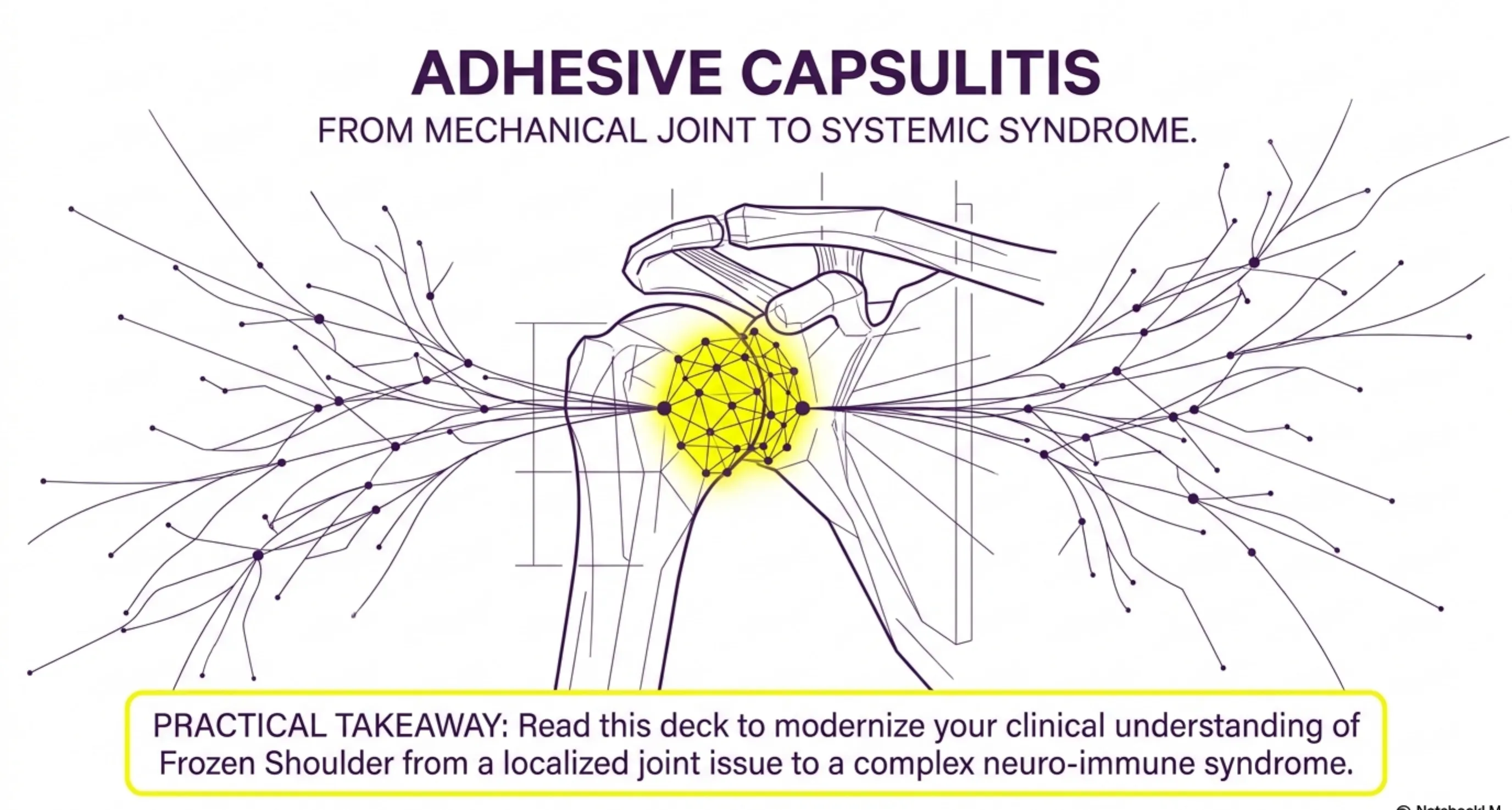
What Frozen Shoulder Actually Is
Adhesive capsulitis. The clinical name for what most people call frozen shoulder. The shoulder joint capsule thickens, becomes inflamed, and forms adhesions. The joint progressively loses range of motion in all directions. Pain ranges from constant ache to sharp episodic stabs that wake people at night.
The condition affects 2 to 5% of the general population and 10 to 38% of people with diabetes. Onset is most common between ages 40 and 60. Women are affected more than men.
Three phases. The freezing phase, typically 6 weeks to 9 months, dominated by pain that gets worse at night. The frozen phase, 4 to 12 months, where pain reduces but stiffness becomes severe. The thawing phase, 6 months to 2 years, where range of motion gradually returns.
Conventional treatment runs through cortisone injections, anti-inflammatories, physiotherapy, and in severe cases, manipulation under anaesthesia or arthroscopic capsular release surgery. Around half of patients fully recover within 1 to 3 years. The other half are left with persistent pain or restricted range of motion.
The patients who do not fully resolve are the ones for whom the standard mechanical model is incomplete.
The 71.6% Finding
A 2025 binational study published in ScienceDirect examined 60 patients diagnosed with adhesive capsulitis. The researchers screened for comorbid anxiety and depression using validated clinical instruments.
71.6% presented with both anxiety and depression disorders. Only 15% had no concomitant psychological disorder. The remainder had one or the other.
Background rates of comorbid anxiety and depression in the general population sit closer to 5 to 10%. The 71.6% figure is dramatically elevated.
A separate systematic review published in PMC analysed multiple studies and confirmed that depression and anxiety are associated with worse subjective and functional baseline scores in patients with frozen shoulder contracture syndrome.
A 2014 retrospective study added the surgical layer. Patients with high baseline depression and anxiety scores had measurably lower success rates after arthroscopic capsular release.
This is the territory where the standard mechanical model starts to look incomplete.
The 2024 Causal Link
Association is not causation. For most of the last decade, the literature on frozen shoulder and psychological factors stayed at the association level.
A 2024 study by Wang and colleagues, published in PMC, used bidirectional Mendelian randomisation to test the causal direction. Mendelian randomisation uses genetic variants as instrumental variables to test whether an exposure causally affects an outcome.
The result. Anxiety disorders showed a statistically significant causal effect on adhesive capsulitis. The reverse direction was not supported. The arrow runs from anxiety to capsulitis.
This is the first study with the methodological strength to support a causal claim. It does not mean anxiety is the only cause. Frozen shoulder is multifactorial: diabetes, thyroid dysfunction, prior shoulder injury, prolonged immobilisation, and inflammatory factors all contribute.
Treating only the mechanical layer in patients who carry chronic anxiety leaves the upstream driver in place.
The Brain-Immune Interplay Model
A 2024 review in Frontiers in Physiology proposed a unified model. The model frames frozen shoulder as a brain-immune interplay condition in which psycho-emotional stress contributes to immune dysregulation, which combines with mechanical and inflammatory factors to produce the characteristic capsular fibrosis.
The mechanism. Chronic stress activates the hypothalamic-pituitary-adrenal axis. Sustained HPA-axis activation alters cortisol patterns and shifts immune function toward chronic low-grade inflammation. The shoulder joint capsule is particularly vulnerable to inflammatory dysregulation.
When the inflammation lands in a shoulder that is also carrying the postural pattern of unprocessed emotional experience (chronic bracing, guarded posture, restricted breathing depth), the local conditions for capsular fibrosis are set.
This model explains why the condition often follows major life stress events by 3 to 12 months. It explains why diabetes is a major risk factor. And it explains why treatment that addresses only the mechanical capsule layer leaves a large subgroup of patients incompletely resolved.
What Physiotherapy Misses
Physiotherapy is the workhorse treatment. It works for many patients. The pieces it does not address are worth naming clearly.
Physiotherapy targets the joint capsule and surrounding muscles. Range of motion exercises, manual therapy, joint mobilisation, sometimes ultrasound or TENS.
What physiotherapy typically does not address. The autonomic nervous system pattern keeping the shoulder in chronic guarding. The unprocessed emotional content the body may be holding in the shoulder girdle. The chronic HPA-axis activation sustaining the systemic inflammatory state. The breathing pattern that has gone shallow around the painful shoulder.
When all these contributors are present and only the mechanical layer is treated, two things happen. Patients improve, but improvement plateaus before full resolution. And the condition has a recurrence pattern: contralateral shoulder onset within 5 years is common.
The contralateral pattern is a useful diagnostic. If your other shoulder froze 3 years after the first one resolved, the upstream driver was never addressed.
Body-First Treatments That Address the Upstream Driver
Five categories of body-first treatment have evidence for addressing the autonomic and emotional contributors.
Somatic experiencing. Developed by Peter Levine. Tracks where stuck patterns live in the body and uses titrated attention to release them. The shoulder girdle is one of the most common storage zones for unprocessed emotional experience.
EMDR. Originally for PTSD, expanded to trauma-rooted chronic pain. Uses bilateral eye movements while the client briefly attends to the disturbing memory. Particularly useful when the frozen shoulder onset followed within a year of a specific identifiable life event.
Trauma-informed yoga. Bessel van der Kolk's research at the Trauma Center showed trauma-sensitive yoga produces significant reductions in PTSD symptoms and chronic pain comparable to evidence-based talk therapies. The mechanism is direct. Yoga retrains the autonomic nervous system to feel safe in the body.
Acupuncture. Strong evidence base for chronic shoulder pain reduction. The American College of Physicians recommends acupuncture as a first-line option for chronic musculoskeletal pain.
Energy healing modalities. 2-Point Healing, Reiki, Healing Touch produce measurable physiological changes including lower respiration rate and reduced systolic blood pressure. The mechanism aligns with parasympathetic activation.
The pattern that consistently produces the best outcomes is parallel work: conventional physiotherapy for the joint, plus body-first work for the upstream driver.
What You Can Do Alongside Treatment
Several self-applied tools meaningfully complement professional treatment.
Daily breathing practice. Box breathing or 4-7-8 breathing for 10 minutes once or twice a day. Both activate the parasympathetic nervous system. The shoulder responds to better breathing patterns within weeks.
EFT tapping for emotional charge. If the frozen shoulder onset followed within a year of a specific stressor, EFT on that scene reduces the somatic charge the body is holding.
Gentle range-of-motion work outside the painful arc. The consistency matters more than the intensity. Daily small movements outperform occasional large ones.
Sleep optimisation. Frozen shoulder pain often peaks at night. Disrupted sleep increases inflammatory markers and stress hormones, which feeds the original condition. A consistent bedtime, dark cool room, and avoiding alcohol within 4 hours of sleep all help.
Side-sleeping support. A body pillow or structured side-sleeping pillow reduces nighttime pain and disrupted sleep. Cheap, effective, undertaught.
Stress reduction during the freezing phase. The freezing phase is when the autonomic component matters most. Anything that meaningfully reduces sympathetic activation during this phase shortens its duration.
When to Seek Professional Help and What Kind
Two professional referrals matter. A good musculoskeletal physiotherapist or shoulder specialist for the mechanical layer. A trauma-informed body practitioner for the autonomic layer.
For the autonomic layer, look for credentials like Somatic Experiencing Practitioner (SEP), EMDR-certified therapist, trauma-sensitive yoga teacher (TCTSY-certified), acupuncturist with chronic pain experience, PSYCH-K or EFT practitioner with at least 3 years of experience, or Magnetic Mind certified consciousness coach.
A useful first session question. "I have frozen shoulder. The conventional treatment is helping with the mechanical layer. I am looking for someone to address the underlying nervous system pattern. Do you have experience with that?" The answer should be specific and confident.
For severe cases that have not responded to 12 to 18 months of conventional treatment, arthroscopic capsular release is a reasonable consideration. The 2014 retrospective study showing worse outcomes in patients with high baseline anxiety and depression suggests doing the body-first nervous-system work in the 2 to 3 months before surgery may improve outcomes.
For most patients, the parallel approach (physiotherapy plus body-first work) produces the best outcomes. Most people see meaningful improvement within 2 to 6 months and full or near-full resolution within 12 to 18 months.
Frequently Asked Questions
Is the emotional component taken seriously by mainstream medicine?
Increasingly. Mayo Clinic, StatPearls, and Cleveland Clinic all reference psychological factors as contributing to onset and outcome. The 2024 Frontiers brain-immune model and Mendelian randomisation study moved the conversation from "associated with" to "causally linked."
I had a major life stressor right before my shoulder froze. Is that coincidence?
Often not. Frozen shoulder onset frequently follows within months of significant emotional shock: bereavement, divorce, major career upheaval, or serious illness in a family member. Phenomenological research published in BMC Musculoskeletal Disorders documents this pattern.
My doctor offered cortisone injections and physical therapy. Should I add body-based work?
Yes, in most cases. The conventional treatments target the inflammation and capsular restriction. Body-based work targets the autonomic nervous system that is upstream of much of the inflammatory dysregulation. The combination consistently outperforms either alone.
Will treating the emotional layer alone fix the physical condition?
Sometimes, but rarely as a first-line approach. The physical contracture has its own momentum. The most evidence-supported pathway is parallel work: conventional physiotherapy plus trauma-informed body work.
How is this different from just calling it psychosomatic?
Psychosomatic implies the pain is imaginary. This is not that. Frozen shoulder produces real biological pathology: capsular fibrosis, mechanical restriction, measurable inflammation. The connection to emotional patterning is about what triggers and sustains the pathology, not about whether the pathology is real.
Continue Reading
More from the blog
Keep exploring
Browse the rest of NeuralFlow's long-form guides on consciousness coaching, energy healing, and mind-body science. Every article is research-backed and built as a multi-format knowledge hub.
Read more articles