Heal Trauma Without Talking: The Body-First Approach

Yes, multiple body-based approaches treat trauma without requiring narrative talk therapy. EMDR is VA first-line for PTSD with strong evidence. Somatic experiencing addresses autonomic activation directly. Trauma-informed yoga has RCT evidence for PTSD. Neurofeedback shows results for treatment-resistant PTSD. EFT has growing evidence base. The honest framing: trauma stored pre-verbally is often easier to reach through body than through words.
Key Questions Answered
Why does talk therapy not always work for trauma?
Because trauma is often stored pre-verbally, in implicit memory and autonomic activation patterns. Bessel van der Kolk's research shows traumatic memory is encoded differently from ordinary autobiographical memory. Narrative therapy can reach the cognitive layer but often leaves the autonomic layer untouched.
What is EMDR and why is it first-line?
Eye Movement Desensitization and Reprocessing. Combines bilateral stimulation (eye movements or tapping) with structured trauma processing. The VA, WHO, and APA all list it as first-line for PTSD. Effect sizes are large, course is typically 8 to 12 sessions, and the protocol does not require detailed verbal description of the trauma.
How does somatic experiencing differ from EMDR?
Somatic experiencing focuses entirely on body sensation and autonomic regulation, with minimal narrative engagement. Peter Levine developed it for trauma where the threat response was incomplete. The protocol is slower than EMDR, more incremental, and works with the body's capacity to complete protective responses.
Does trauma-informed yoga actually help PTSD?
Yes. The 2014 RCT by Bessel van der Kolk and colleagues at Trauma Center Yoga showed effect sizes comparable to EMDR for chronic PTSD. The mechanism is interoceptive awareness and autonomic regulation. The course is 10 weeks of structured trauma-informed yoga.
When is body-first work the right choice?
When traumatic memory is pre-verbal (childhood trauma before age 4 to 5). When dissociation is significant. When narrative therapy has produced limited results. When the client cannot tolerate detailed trauma narrative without re-traumatisation. When autonomic dysregulation is the primary symptom.
In This Guide
Key Takeaways
- Bessel van der Kolk's research established that trauma is often stored pre-verbally and cannot always be reached through narrative therapy alone.
- EMDR is recommended as first-line PTSD treatment by the VA, WHO, and APA, with large effect sizes across multiple meta-analyses.
- Somatic experiencing, developed by Peter Levine, addresses autonomic activation directly without requiring detailed verbal narrative.
- Trauma-informed yoga has RCT evidence (van der Kolk 2014) showing effect sizes comparable to EMDR for chronic PTSD.
- The honest framing for trauma treatment is layered. Body-first for autonomic regulation. Narrative work for meaning. Most patients benefit from combinations.
Listen to the deep-dive on this article
A two-host audio overview of the key ideas. Origins, mechanism, evidence, and what to expect. Useful when you would rather listen than read.
Why Words Do Not Always Reach Trauma
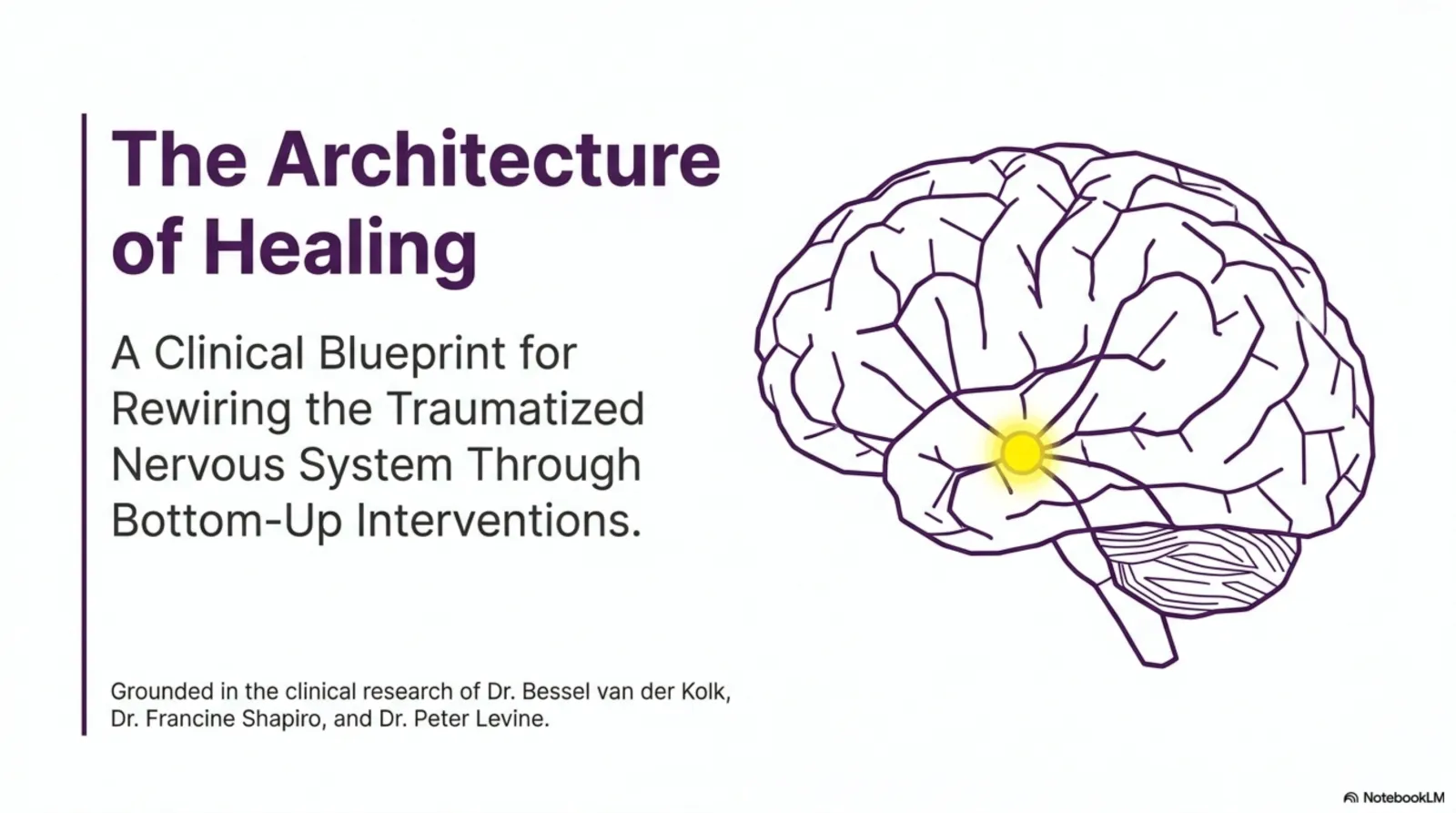
Bessel van der Kolk's research at the Trauma Center transformed how the field understands trauma. The core finding. Traumatic memory is encoded differently from ordinary autobiographical memory. It often sits in implicit memory, autonomic activation patterns, and somatic sensation rather than in narrative.
The neuroscience supports this. Functional imaging during traumatic recall shows reduced activity in Broca's area (the brain region for verbal expression) and increased activity in the right hemisphere and limbic system. Patients in the middle of a flashback often cannot describe what is happening because the verbal-processing areas are temporarily offline.
For pre-verbal trauma (before approximately age 4 to 5), the encoding never had verbal access in the first place. The body holds the trauma. The conscious mind has no language for it.
This means narrative therapy has structural limits for many trauma presentations. It can reach the verbal layer well. It often cannot reach the implicit memory and autonomic activation layers that drive most trauma symptoms.
Body-first approaches work directly at the layers narrative cannot reach. This is not "instead of" narrative therapy for trauma where narrative works. It is "the right tool when narrative is not the right tool."
EMDR: The Evidence Leader
EMDR has the strongest evidence base of any body-first trauma approach. The Department of Veterans Affairs, the World Health Organisation, and the American Psychological Association all list it as first-line treatment for PTSD.
The protocol involves identifying a specific traumatic memory, holding it in mind while engaging in bilateral stimulation (eye movements following the therapist's hand, or alternating taps), and noticing what shifts. Across 60 to 90 minute sessions, the memory typically loses its disturbing intensity, and adaptive cognitions emerge.
Effect sizes for single-incident PTSD are large. 8 to 12 sessions typically reduces PTSD diagnoses to subclinical levels. For complex PTSD with multiple traumas across childhood, the course is longer (6 to 18 months) and includes preparation work for autonomic regulation before processing begins.
The advantage over narrative-based PTSD treatments. EMDR does not require detailed verbal description of the trauma. The patient holds the memory image while the bilateral stimulation does the processing work. Less re-traumatisation risk. Faster results in many cases.
Limitations. Some patients do not respond. Severe dissociation requires extensive preparation before EMDR can be safely used. Comorbid substance use needs to be addressed first.
Somatic Experiencing: Working at the Autonomic Layer
Peter Levine developed somatic experiencing from observing how animals in the wild metabolise threat events. The protective responses (fight, flight, freeze) cycle through and resolve when uninterrupted. In humans, social and cognitive constraints often interrupt these responses, leaving them stuck in the body.
The protocol works with the body's natural capacity to complete what was interrupted. The therapist tracks subtle body sensations and movements, helping the client notice what wants to happen but never did. A protective gesture. A defensive stance. A directional movement away from threat.
The work is slow and incremental. Sessions involve far more attention to body sensation than narrative content. The autonomic system gradually integrates what could not be processed in real time.
For whom this fits best. Trauma where the threat response was clearly interrupted (held still during attack, unable to flee, frozen). Pre-verbal trauma where narrative is not available. Trauma in patients with high dissociation. Trauma where standard therapies have produced limited result.
The training is rigorous (3-year somatic experiencing certification). The protocol takes longer than EMDR but reaches material EMDR sometimes cannot. Many trauma-trained therapists use both approaches and select based on case features.
Trauma-Informed Yoga: The 2014 RCT
The 2014 RCT by Bessel van der Kolk and colleagues at the Trauma Center applied a 10-week trauma-informed yoga protocol to chronic PTSD patients with limited response to other treatments. Effect sizes were comparable to EMDR. The PTSD diagnosis criteria were met by significantly fewer participants in the yoga group than in the control group at follow-up.
The mechanism is interoceptive awareness and autonomic regulation. Trauma disrupts the patient's relationship with their own body. They cannot read their internal signals. They cannot feel safe in their skin. The yoga protocol rebuilds this relationship through specific postures, breath work, and attention practices designed for trauma sensitivity.
Trauma-informed yoga differs from regular yoga in important ways. No physical adjustments by the instructor. Choice and consent emphasised throughout. Attention to subtle body sensation rather than achievement of postures. Permission to opt out of any practice. No narrative engagement with trauma content.
For whom this fits. Trauma survivors who want a low-intensity entry point. Patients with high somatic-arousal symptoms. Patients in maintenance phase after primary treatment. Patients who want a self-applicable practice they can continue indefinitely.
For whom this does not fit alone. Severe acute PTSD. Active dissociative episodes. Trauma where specific intervention (EMDR, somatic experiencing) is needed first. The yoga is often best added to existing treatment rather than used alone.
Neurofeedback and EFT: Additional Options
Neurofeedback uses real-time EEG feedback to help patients shift brainwave patterns. For trauma, the targeted shifts are typically reduction of high-beta (associated with hypervigilance) and increase of alpha (associated with calm). The 2018 RCT by van der Kolk and colleagues showed effect sizes comparable to other established trauma treatments.
Course length. 30 to 40 sessions is typical. The cost can be substantial, sometimes $4000 to $8000 for a full course.
For whom it fits. Treatment-resistant PTSD where other approaches have stalled. Patients who prefer technology-assisted modalities. Patients with primary autonomic dysregulation as the main feature.
EFT (Emotional Freedom Technique) combines fingertip tapping on acupressure points with verbal phrases. The 2018 Stapleton meta-analysis identified strong effect sizes for PTSD across multiple RCTs. Effect sizes were large for self-applied protocols. The course is shorter than EMDR (typically 6 to 8 sessions for single-incident PTSD).
For whom EFT fits. Patients who want a low-cost self-applicable component. Patients without access to trauma-specialist therapists. Patients with mild-to-moderate trauma symptoms. Patients who want to add a daily-practice tool to existing treatment.
The pattern across these modalities. Each addresses a different aspect of how trauma is held in the body. The strongest evidence-based options are EMDR and trauma-informed yoga, with somatic experiencing, neurofeedback, and EFT as well-supported alternatives or additions.
Choosing the Right Approach for Your Trauma
The approach that fits best depends on trauma type and presentation.
Single-incident adult trauma (assault, accident, single severe event). EMDR is typically first-line. Course is short, evidence is strong, and the protocol is well-suited to this trauma type.
Pre-verbal childhood trauma (before age 4 to 5). Somatic experiencing or trauma-informed yoga often works better than EMDR. The verbal-memory access EMDR uses is not available for pre-verbal trauma.
Complex PTSD from sustained childhood trauma. Layered approach typically works best. Phase 1: stabilisation and autonomic regulation, often through somatic experiencing or trauma-informed yoga. Phase 2: trauma processing through EMDR or extended somatic work. Phase 3: integration and identity work. Course is 12 to 24 months minimum.
Treatment-resistant PTSD that has not responded to first-line approaches. Neurofeedback and trauma-informed yoga have shown effects in this group. Psychedelic-assisted therapy in clinical trials shows promise.
Self-applicable maintenance after primary treatment. EFT, trauma-informed yoga, and somatic awareness practices all work well for ongoing regulation.
The honest framing. There is no single right approach for trauma. The strongest evidence base sits with EMDR for single-incident and trauma-informed yoga for chronic. For complex presentations, layered combinations consistently outperform any single modality. Coordinated care across modalities is the gold standard.
Frequently Asked Questions
Is body-first work safer than talk therapy for trauma?
For some patients, yes. Patients with severe dissociation, complex trauma, or pre-verbal trauma often re-traumatise from detailed narrative work in standard therapy. Body-first approaches reduce this risk by working with regulation before processing.
Can I do somatic work without a therapist?
Self-guided somatic awareness practices are useful for daily regulation. Actual trauma processing requires a trained practitioner. Somatic experiencing certification is rigorous (3-year programme), and the protocols require clinical judgment about pacing and titration.
How long does body-first trauma treatment take?
EMDR for single-incident PTSD: 8 to 12 sessions. EMDR for complex PTSD: 6 to 18 months. Somatic experiencing: typically longer, 6 months to 2 years. Trauma-informed yoga: 10 weeks for the structured RCT protocol, ongoing for maintenance.
What about psychedelic-assisted therapy?
MDMA-assisted therapy showed strong RCT effects for PTSD in Phase 3 trials. Psilocybin shows promise for treatment-resistant depression. Both remain in clinical trial pathways in most countries. They are not currently standard care but may become so within several years.
Should I stop talk therapy if I add body-based work?
Usually no. Combined approaches consistently outperform single-modality treatment for complex trauma. Coordinate your providers. The body-based work and the talk-based work address different layers and reinforce each other.
Continue Reading
More from the blog
Emotional Trauma and Physical Pain: Breaking the Cycle
The bidirectional relationship between emotional trauma and physical pain, and how to interrupt it.
science-and-evidenceCan Emotional Trauma Cause Physical Pain? What Science Tells Us
The neuroscience and clinical evidence behind trauma-to-pain pathways in the body.
Keep exploring
Browse the rest of NeuralFlow's long-form guides on consciousness coaching, energy healing, and mind-body science. Every article is research-backed and built as a multi-format knowledge hub.
Read more articles