Healing Grief: When Talk Therapy Is Not Enough

Talk therapy works well for acute uncomplicated grief. For prolonged grief disorder (the diagnostic category for grief that does not resolve naturally), body-based approaches are increasingly part of best practice. EMDR has documented effects on grief processing. Somatic experiencing addresses the autonomic activation that traps grief in the body. The honest framing: words help with the meaning of loss, body-based work helps with the physical residue of loss.
Key Questions Answered
When does grief need more than talk therapy?
When grief persists at high intensity beyond 12 months (the diagnostic threshold for prolonged grief disorder). When the body shows persistent physical symptoms (chronic tension, sleep disturbance, autonomic dysregulation). When standard grief support has produced limited improvement. When the loss involved trauma (sudden death, witnessed death, traumatic circumstances).
What does body-based grief work actually do?
It addresses the physical and autonomic residue of loss. Grief activates the same stress-response systems as physical threat. When unresolved, this activation becomes chronic, producing tension, fatigue, sleep disruption, and the "stuck" feeling that talk alone cannot move. Body-based work releases the autonomic load.
Is EMDR effective for grief?
Yes. Pilot studies of EMDR for prolonged grief show measurable reductions in grief intensity and PTSD-like symptoms. The mechanism is processing of the traumatic memory components that often accompany sudden, unexpected, or witnessed loss.
What is somatic experiencing?
A body-based therapy developed by Peter Levine that addresses the autonomic activation associated with trauma and unresolved stress responses. For grief, somatic experiencing helps complete the autonomic responses that loss interrupted.
When is body-based work the wrong choice?
In acute grief in the first 6 to 12 months for most people. Time and standard grief support are the right primary tools. When suicide risk is present, or active complicated mourning, professional grief therapy with appropriate clinical training is required first.
In This Guide
Key Takeaways
- Prolonged grief disorder is the diagnostic category for grief that persists at high intensity beyond 12 months. It is recognised in DSM-5-TR and ICD-11.
- Bessel van der Kolk's research on the body in trauma applies to grief. The autonomic load from loss creates physical residue that words alone cannot address.
- EMDR pilot studies for prolonged grief show measurable reductions in grief intensity. The protocol addresses the traumatic memory components that often accompany sudden loss.
- Somatic experiencing addresses the autonomic activation associated with grief. Peter Levine's framework helps complete responses that loss interrupted.
- The honest framing is layered. Words for meaning. Body-based work for physical residue. Time and connection for integration. Most people benefit from combinations across layers.
Listen to the deep-dive on this article
A two-host audio overview of the key ideas. Origins, mechanism, evidence, and what to expect. Useful when you would rather listen than read.
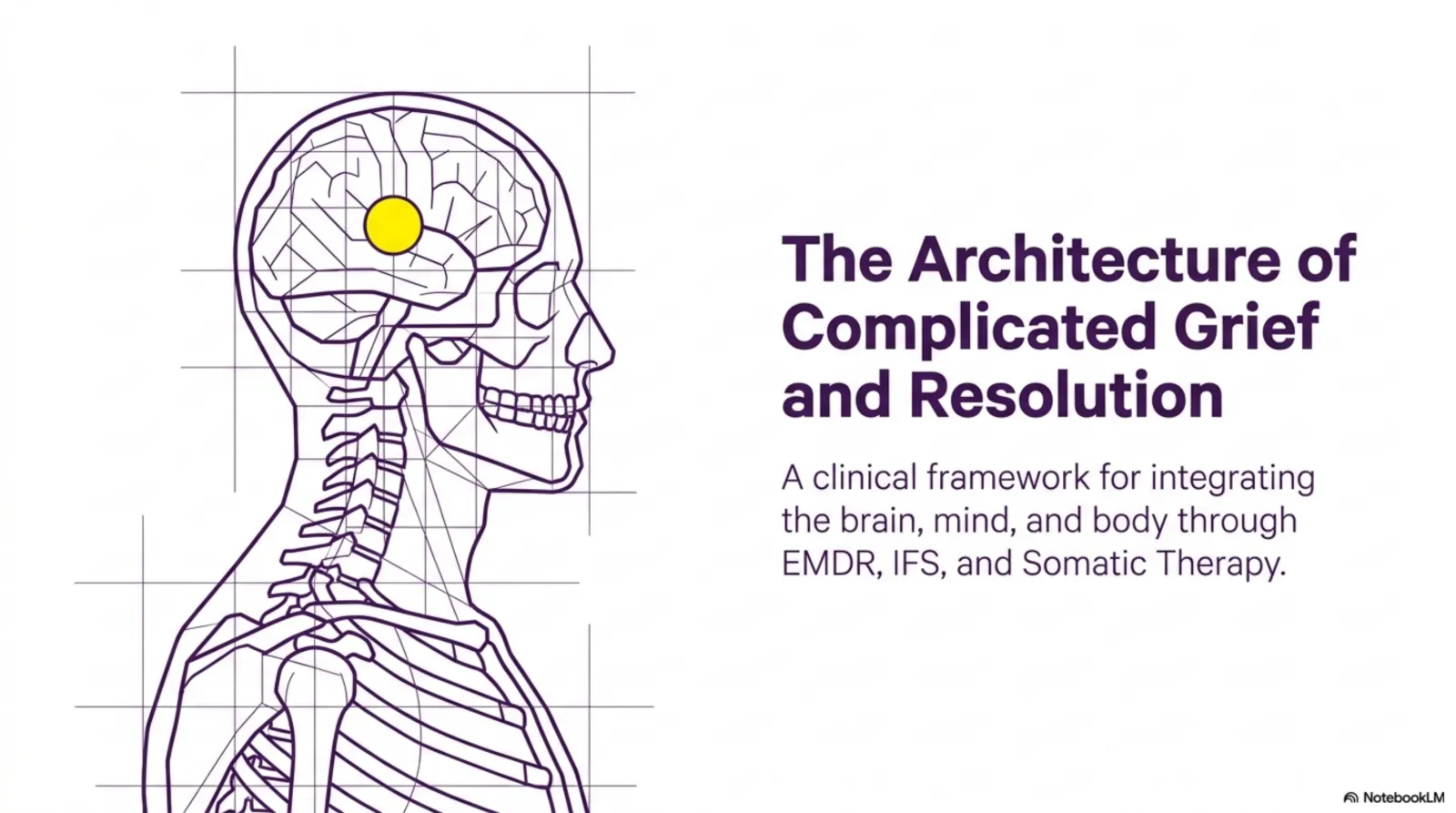
Two Kinds of Grief Need Different Tools
Grief is not one thing. There is acute grief, which most people experience after significant loss and which gradually integrates over 6 to 12 months. There is also complicated or prolonged grief, which persists at high intensity, disrupts function, and does not resolve through ordinary processes.
For acute grief, the right tools are time, social connection, ritual, and supportive presence. Standard grief therapy helps with meaning-making and the practical tasks of life rebuilding. Most people, given these supports, find their way through.
For prolonged grief disorder (now a recognised diagnosis in DSM-5-TR and ICD-11), the standard tools often are not enough. The grief becomes stuck. The body holds it. Words and meaning-making circle without producing release.
This is where body-based approaches earn their place. Not as primary treatment for acute grief. As specific treatment for the prolonged or traumatic forms that need different intervention.
Why Grief Gets Stuck in the Body
Bessel van der Kolk's research on trauma applies directly to grief. Loss activates threat-response systems. Sympathetic nervous system activation. HPA axis activation. The same biology that responds to physical danger.
Normally, this activation cycles through and resolves. The autonomic system returns to balance. The grief integrates into a new sense of self that includes the loss without being dominated by it.
Sometimes the resolution does not happen. The activation becomes chronic. The body stays mobilised in a low-grade alarm state. The physical signs are familiar to anyone who has been through this. Constant tension, often in the chest, throat, or abdomen. Sleep disruption. Fatigue that does not respond to rest. A sense of being "in" the grief without being able to fully feel or process it.
This is the body holding what the mind cannot fully process. The conscious mind may have done excellent meaning-making work. The autonomic system has not received the signal that the threat is over.
Body-based work addresses this directly. It bypasses the conscious-meaning layer (which is often already well-tended) and works directly with the autonomic activation that has not resolved.
EMDR for Grief: When Loss Includes Trauma
EMDR has documented effects on prolonged grief, particularly when the loss involved traumatic elements. Sudden death. Witnessed death. Death from violence or accident. Loss in circumstances the bereaved feels guilty about.
The EMDR grief protocol applies the same bilateral stimulation framework used for PTSD to grief-specific memories and triggers. The aim is processing of the traumatic memory components so they integrate into ordinary autobiographical memory rather than continuing to function as intrusive triggers.
Pilot studies show reductions in grief intensity scores, reductions in PTSD-like symptoms (intrusive thoughts, hypervigilance, avoidance), and improvements in functional grief integration. Effect sizes are moderate. The studies are typically small but consistent.
Who fits this protocol. People whose grief involves traumatic memory components. People who have intrusive memories of the dying or the discovery of death. People whose grief includes survivor guilt or rumination on what could have been done differently.
Who does not fit. People whose grief is uncomplicated by traumatic elements. The standard supportive approach is usually sufficient. EMDR is overkill when the grief is doing what grief does.
Somatic Experiencing for Stuck Grief
Somatic experiencing is a body-based therapy developed by Peter Levine that addresses chronic autonomic activation. For grief, the protocol works with the autonomic responses that the loss interrupted or could not complete.
The mechanism. Many losses involve responses the bereaved could not enact. The protective response that came too late. The fight or flight that had no target. The sustained alertness that never received the signal to stand down. These responses live in the autonomic system as unresolved activation.
Somatic experiencing helps complete these responses through small, titrated movements and attention practices. The aim is not to relive the loss but to allow the autonomic system to finish what was interrupted. The practical effect is that the body stops holding the chronic alarm state.
Sessions look different from talk therapy. Less narrative, more attention to body sensation. The work is slow and incremental. Five to fifteen sessions is a typical course.
The fit is strongest for grief that has a clear "frozen" quality. The bereaved feels stuck rather than sad, numb rather than mourning, tense rather than tearful. Standard grief therapy that emphasises feeling and expression often does not work well here. The autonomic state needs intervention before the feelings can flow.
Consciousness Coaching for the Identity Reorganisation
Loss often produces identity reorganisation. The bereaved is no longer a parent of, no longer married to, no longer the daughter of someone alive. The roles that organised daily life are gone or radically altered.
Consciousness coaching, drawing on the same principles as the Magnetic Mind Method and similar frameworks, addresses this identity layer directly. The work is not about the immediate grief or the autonomic activation. It is about the reconstruction of self that grief eventually requires.
This typically comes later in the grief process. Months to years after the loss. After the acute work is done and the autonomic load has reduced. The question becomes "who am I now?"
The work involves identifying the limiting beliefs that arose from the loss. ("I cannot be happy without them." "I do not deserve to enjoy life when they cannot." "Joy is betrayal.") These beliefs, often forming silently in early grief, can persist for years and prevent integration.
The coaching addresses these directly through belief-revision processes. The practical effect is that the bereaved can move forward with the loss as part of their history without it dominating their present.
This is not about "moving on." It is about the loss becoming part of the self rather than the entire self.
Putting the Layers Together
Most people with prolonged or complicated grief benefit from layered support rather than a single approach.
Standard grief therapy or counseling for the meaning-making layer. Working through the story, the relationship, the regrets, the gratitudes, the practical adjustments. This is the primary work for most grief and remains useful even when other layers are added.
EMDR if traumatic memory components are present. Sudden, witnessed, or violent loss often includes intrusive memory features that benefit from specific processing.
Somatic experiencing or other body-based work if the grief has become "stuck" or "frozen" with chronic autonomic activation. This addresses the body layer that words alone cannot reach.
Consciousness coaching for the longer-term identity reorganisation, particularly when limiting beliefs from the loss are blocking forward integration.
The layers work in different time frames. Standard grief therapy from the start. Body-based work when the autonomic load is the limiting factor. Identity-level work as the long-term integration challenge.
Most prolonged grief responds to combinations across these layers. Single-modality approaches often help with one layer while leaving others untouched. The honest practitioners across modalities know this and refer across when their layer is not the primary need.
Frequently Asked Questions
How is grief different from depression?
Grief is loss-specific and waxes and waves. Depression is more pervasive and constant. Grief includes positive memories of the loved one alongside the pain. Depression rarely does. Both can coexist, particularly when grief becomes complicated. Treatment differs accordingly.
How long is "normal" grief?
Acute grief intensity typically reduces over 6 to 12 months for most people. Underlying grief continues forever in some sense, but daily functioning returns. Persistent high-intensity grief beyond 12 months meets criteria for prolonged grief disorder and benefits from professional treatment.
Why does grief get stuck in the body?
Grief activates the same threat-response systems as physical danger. Sustained activation without resolution becomes chronic. Chronic autonomic activation produces tension patterns, sleep disruption, fatigue, and the physical sense of being "stuck." Body-based work targets this chronic activation directly.
Should I avoid body-based work in early grief?
For most people, yes. The first 6 to 12 months benefit most from time, social support, standard grief therapy, and rest. Body-based work earns its place when grief is complicated, traumatic, or has not resolved with standard support.
Can grief therapy and body-based work be combined?
Yes, and often this is the strongest pattern. A grief therapist for the meaning and integration layer. A somatic practitioner for the body layer. The two coordinate rather than compete. Many trauma-trained therapists work in both modes themselves.
Continue Reading
More from the blog
Keep exploring
Browse the rest of NeuralFlow's long-form guides on consciousness coaching, energy healing, and mind-body science. Every article is research-backed and built as a multi-format knowledge hub.
Read more articles