Feeling Stuck in Life? 7 Signs You Need a Consciousness Shift, Not Just a Plan

Feeling stuck rarely means you need a better plan. Self-regulation research shows that goal pursuit requires the conscious, subconscious, and unconscious layers of mind to align. When they do not, the prefrontal cortex burns through its glucose budget on internal conflict and behaviour reverts to encoded patterns. Seven signs distinguish a willpower problem from an identity problem. The work that resolves identity-level stuckness is different from goal-setting and uses techniques like Evidence Stacking, Cognitive Reappraisal, and Real-Time Neuroplasticity™ to rewire the substrate.
Key Questions Answered
How do I tell if I need a plan or a consciousness shift?
Run the seven signs in this article. Three or more apply means the limiting factor is identity-level, not strategy-level. Goal-setting addresses the conscious mind. Consciousness coaching addresses the subconscious self-schema and the unconscious survival layer that override conscious intention.
Why do my plans stall at the same point even when the plans are different?
Because the plateau matches the ceiling of your self-schema, not the ceiling of the plan. Tony Robbins frames it this way: "the only thing that's keeping you from getting what you want is the story you keep telling yourself." Different plans, same story, same plateau.
What is actually happening in the brain when I cannot make myself act?
The prefrontal cortex (PFC) is acting as the executive control network, but it consumes about 20% of the brain's glucose despite being only 12% of its volume. Decision fatigue is real metabolism, not character. And the amygdala's threat response can hijack the PFC when the subconscious reads a goal as dangerous.
Can I do this work without a coach?
Yes for the foundational protocols. A Courage Journal that records one moment of brave action per day, scheduling demanding decisions for the morning when PFC efficiency is at 95–100%, and twelve-minute micro-recovery breaks all work self-applied. Identity-level rewiring usually benefits from a trained practitioner.
How long does the rewiring take?
Neuroplasticity research, including the Draganski et al. 2004 work cited by Ann Smyth, confirms adult brains remain plastic. Behavioural automaticity for new habits ranges from weeks to months depending on the layer being addressed. Identity-level beliefs typically take longer than surface habits because the subconscious enforces the prior self-concept.
In This Guide
- Why Goal-Setting Stops Working at the Same Point
- Sign 1. Your Willpower Collapses at the Same Time Every Day
- Sign 2. Your Three Answers Do Not Match
- Sign 3. The Same Belief Runs Across Different Domains
- Sign 4. You Know What To Do And Cannot Do It
- Sign 5. You Abort In The 200-Millisecond Window
- Sign 6. You Are Waiting To Feel Ready Before You Act
- Sign 7. Your Environment Contradicts The Change
- What a Consciousness Shift Actually Looks Like
- What Is the Bottom Line?
Key Takeaways
- Self-regulation depends on three brain regions in coordination: the dorsolateral prefrontal cortex (DLPFC) suppresses limbic signals, the anterior cingulate cortex (ACC) monitors the conflict between "want" and "should", and the orbitofrontal cortex (OFC) evaluates choice value.
- The PFC consumes about 20% of the brain's glucose while representing 12% of its volume; decision fatigue follows a measurable curve with PFC efficiency dropping from 95–100% in early morning to 30–40% in evening.
- Limiting beliefs are unconscious defence mechanisms. When the subconscious reads a goal as dangerous or unlikely, it triggers self-sabotage through procrastination, overthinking, or impostor syndrome.
- Bruce Lipton's research on early development establishes that children operate in a near-hypnotic state until age seven, and the environmental cues absorbed in that window form the basis of adult limiting beliefs.
- Sustained change comes from synchronising three layers (conscious, subconscious, unconscious) using techniques like Evidence Stacking, Visualisation, Real-Time Neuroplasticity™, and Cognitive Reappraisal, not from willpower alone.
Listen to the deep-dive on this article
A two-host audio overview of the key ideas. Origins, mechanism, evidence, and what to expect. Useful when you would rather listen than read.
Why Goal-Setting Stops Working at the Same Point
People who feel stuck have usually tried planning. Several plans. Different planning systems. Productivity tools. Goal-setting workshops. The Friday review, the morning routine, the year-in-review document.
The pattern is recognisable. Each plan starts strong. Energy peaks for two to four weeks. Then a plateau arrives at the same structural point. Different plans. Same plateau.
This is the first signal that the limiting factor is not the plan.
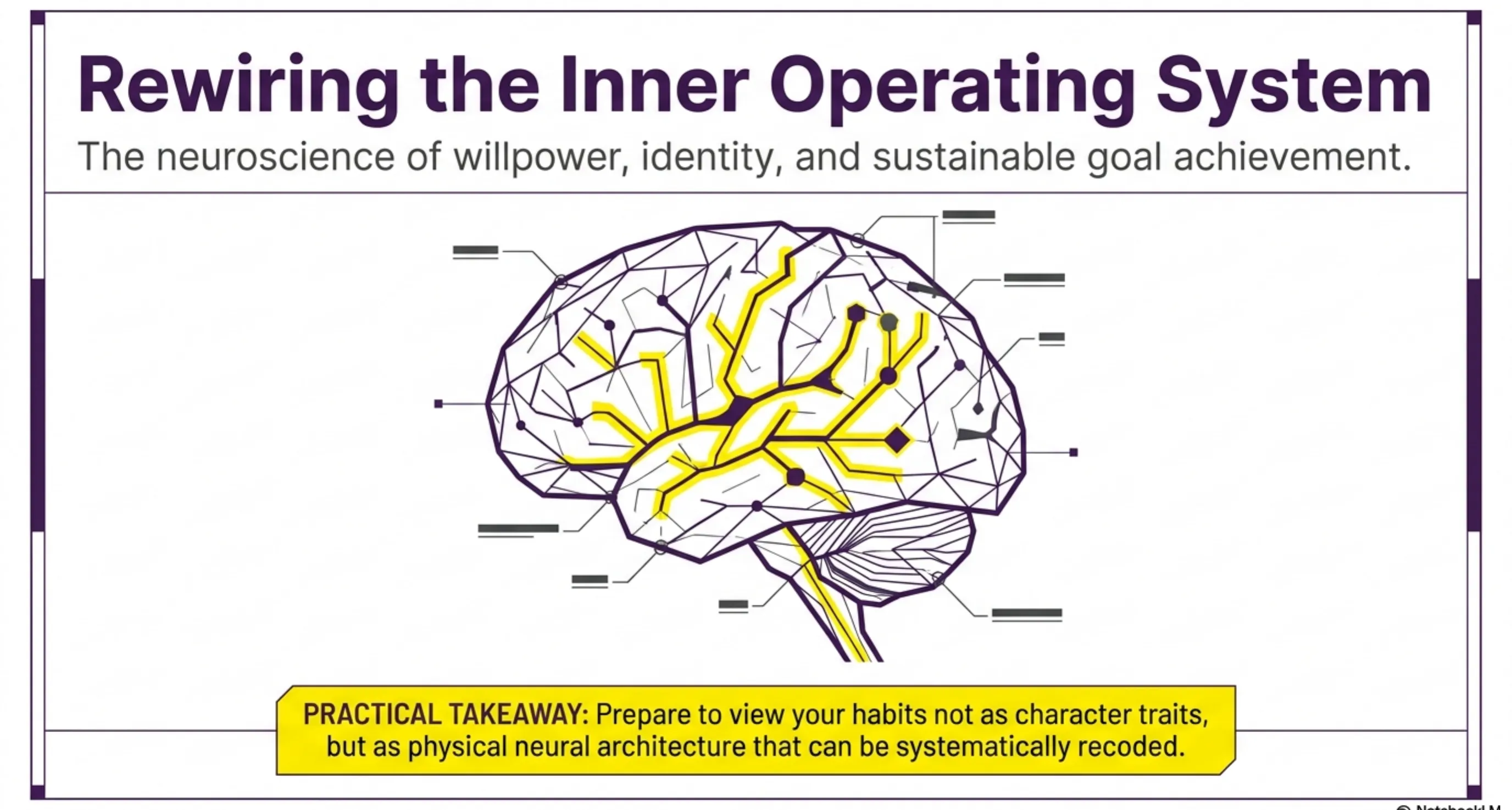
Self-regulation research describes three brain regions that together form the executive control network. The dorsolateral prefrontal cortex (DLPFC) acts as the executive director, actively suppressing signals from the limbic system. The anterior cingulate cortex (ACC) monitors the conflict between what you want and what you "should" do. The orbitofrontal cortex (OFC) evaluates the relative value of options. The three coordinate to produce intentional behaviour.
The PFC consumes approximately 20% of the brain's glucose while representing only 12% of its volume. Self-control predictably deteriorates through the day:
| Time of Day | PFC Efficiency | Suited For |
|---|---|---|
| Early Morning | 95–100% | Major decisions, complex tasks, goal setting |
| Mid-Morning | 85–90% | Problem-solving, creative work |
| Early Afternoon | 70–75% | Social interactions, planning |
| Evening | 30–40% | Reflection, relaxation; avoid relationship conflicts |
That is the metabolism. Underneath the metabolism are three layers of mind that must align for behaviour to follow intention. The conscious mind plans and decides. The subconscious carries beliefs absorbed from repeated experience, often by age seven. The unconscious is survival-based and prioritises safety over growth, scanning for threats and triggering stress responses.
Goals fail when the layers are out of sync. The conscious mind says go, the subconscious carries a contradicting belief, and the unconscious reads the new direction as threat. The seven signs below are the most reliable diagnostic.
Sign 1. Your Willpower Collapses at the Same Time Every Day
You start the day disciplined and end it with a stack of decisions you did not make. The plan was reasonable at 7 a.m. By 5 p.m. it is theoretical.
This is decision fatigue. The PFC has burned through its glucose budget. Efficiency that started at 95–100% in early morning has dropped to 30–40% by evening. The plan did not fail because you were weak. The plan failed because it was scheduled to require executive function during the part of the day when executive function is metabolically depleted.
The fix is partly architectural. Schedule major decisions, complex tasks, and goal-setting work for early morning. Reserve afternoons for problem-solving and planning. Move relationship conversations and consequential negotiations away from evenings. Recent research suggests that holding a growth mindset about willpower (viewing it as a trainable battery rather than a finite tank) can mitigate the drop.
Twelve-minute micro-recovery breaks between high-demand tasks can restore PFC activation closer to baseline. Most people skip them.
Sign 2. Your Three Answers Do Not Match
Run the Pause and Scan protocol on a decision you have been circling. Ask three questions in sequence.
What does my logical mind say? What do I believe is true here? What does my body feel?
If the answers diverge, the three layers of mind are out of sync. This is the most diagnostic moment in identity work. The logical answer is conscious. The belief is subconscious. The body sensation is unconscious. When all three align, action follows easily. When they conflict, willpower has to span the gap, and willpower is metabolically expensive.
Most people never check the three answers separately. They feel resistance and call it laziness. The actual signal is internal disagreement that has not been surfaced.
Interoceptive awareness, the capacity to perceive internal bodily sensations as data rather than commands to react, is the trainable skill that makes the third question useful. Heart rate, breath pattern, and tension are signals from the unconscious about whether the next step is safe.
Sign 3. The Same Belief Runs Across Different Domains
Career stalls at one income level. Relationships hit the same intimacy threshold and fracture. Money cycles between earning and losing. Creative work reaches the same point and stops.
The same pattern. Different domains. Different surface variables.
Tony Robbins frames the substrate this way: "the only thing that's keeping you from getting what you want is the story you keep telling yourself." The framing maps onto self-schema theory. Self-schema is the core self-concept, often constructed from old data that no longer serves current goals. It runs underneath conscious choice and acts as a filter that dictates what the system believes is possible.
Bruce Lipton notes that children operate in a near-hypnotic state until age seven, soaking up environmental cues that form the basis of these beliefs. If a child internalised "I am not the one who succeeds" through repeated experience, the adult version of that person will sabotage success across multiple domains until the underlying schema is revised.
The names for the schema differ across modalities. The mechanism is the same. The substrate runs the patterns.
Sign 4. You Know What To Do And Cannot Do It
You know exactly what you should do. You can articulate the steps. You have read the books, taken the courses, paid for the coaching. The information layer is saturated.
And the actions do not happen.
Limiting beliefs are unconscious defence mechanisms used to avoid negative emotions like anxiety or rejection. When the subconscious believes a goal is "dangerous" or "unlikely," it triggers self-sabotage through three predictable channels. Procrastination delays the action. Overthinking dilutes the action. Impostor syndrome convinces the system the action is not legitimate.
None of these are willpower failures. They are the unconscious doing exactly what it was designed to do: prevent the system from approaching what the substrate has flagged as unsafe.
Information at the conscious layer cannot dissolve a defence mechanism at the unconscious layer. The right intervention works at the layer where the defence lives.
Sign 5. You Abort In The 200-Millisecond Window
There is a specific moment between an impulse and an action. Self-regulation research locates a roughly 200-millisecond window in which the brain registers conflict and the executive system decides whether to follow through or override the impulse.
Real-Time Neuroplasticity™ is the practice of intentionally targeting that window with a pattern interrupt. Notice the conflict. Insert a deliberate breath. Choose the new pattern instead of the default one. The choice has to be made fast because the window closes fast.
People who feel stuck often abort in this window without noticing. The conflict registers, the unconscious wins, and the action does not happen. Once the window has closed, the cognitive justification arrives ("I will do it tomorrow") and the system explains the abort to itself.
Specialised regions in the right inferior frontal gyrus handle impulse inhibition. They strengthen with practice. The first hundred reps feel forced. The thousandth feels automatic.
Sign 6. You Are Waiting To Feel Ready Before You Act
Confidence is not the precondition for action. The order is reversed.
Simon Alexander Ong frames the rule directly: "Confidence isn't the starting line. It's the finish line." Competence is earned through action, which then produces confidence. Waiting for the feeling of readiness before starting is one of the most reliable signs that a limiting belief is in charge.
The same point sits in Ong's metaphor of the bird and the branch. A bird sitting on a tree is never afraid of the branch breaking because its trust is not in the branch but in its own wings. True security is trust in the capacity to bounce back, not trust that conditions will hold steady.
Cognitive reappraisal works on this directly. Instead of suppressing fear, change the interpretation of it. Fear at the threshold of a stretch goal is not a stop signal. It is a signal that growth is happening. The reframe shifts the autonomic response and frees the action.
This is one piece. Action precedes confidence. Reframe the fear. Then move.
Sign 7. Your Environment Contradicts The Change
One workplace metaphor surfaces this clearly. If you are trying to stay warm in a freezer, your environment will eventually override your willpower.
Limiting beliefs in workplaces aggregate into culture. Two surface most often. The Need for Approval ("I must be liked by all colleagues") drives yes-man behaviour, the bandwagon effect, and eventual burnout. Perfectionism (the refusal to share work until it is "perfect") slows team velocity and is often a mask for fear of judgment.
Both beliefs respond to environmental design more than to internal pep talks. The 30/60/90 framework is one practical tool. Encourage sharing work at 30% completion to break the perfectionism cycle and accelerate feedback loops.
For individuals, the principle is the same. Audit your inputs. Curate social media. Reshape the social circles that reinforce the old self-concept. Environment beats willpower because the unconscious reads environment as identity, and identity runs the substrate of behaviour.
What a Consciousness Shift Actually Looks Like
Real change strengthens three specific neural systems in coordination: impulse inhibition, goal maintenance, and emotional regulation. The Three Pillars of Self-Control.
Evidence Stacking. Build self-efficacy by following through on small promises to the self. Each kept promise signals the brain that you are "someone who gets things done." A Courage Journal that records one moment of brave action per day is the simplest implementation. The accumulating evidence revises the self-schema faster than any amount of conscious affirmation.
Visualisation. Mental rehearsal activates the same neural circuits as physical performance. This creates a mental blueprint for the future self. Run the visualisation in present tense, with sensory detail, in the morning when PFC efficiency is highest.
Real-Time Neuroplasticity™. Target the 200-millisecond conflict window with a pattern interrupt. Notice the impulse, insert a breath, choose the new response. Repeated across weeks, this writes the new pattern into the substrate.
Cognitive Reappraisal. Change the interpretation of stressors instead of suppressing them. Fear of visibility becomes a signal of growth. Discomfort at the threshold of change becomes evidence that the work is reaching the substrate.
Ann Smyth puts the underlying principle plainly: "Identity isn't static; it evolves, and when guided consciously, can align with the life you deeply desire." The neuroplasticity research she draws on, including Draganski et al. 2004, confirms that adult brains remain plastic and capable of structural changes through consistent practice.
Practitioners who specialise in this layer combine these techniques into a structured engagement. Greg Jones works with clients across 6 to 12 sessions, using consciousness coaching and 2-Point Healing in a layered approach informed by the Magnetic Mind Method. Sessions are available in person in Motueka and via Zoom worldwide. The Free 90-Minute Workshop is the most common starting point for people running the Pause and Scan on themselves and finding their three answers do not match.
What Is the Bottom Line?
If your willpower collapses on a predictable curve, your plans are scheduled against your metabolism.
If your three answers do not match, the layers of mind are out of sync.
If the same belief runs across different domains, the self-schema is what is stuck.
The work that resolves identity-level stuckness is different from goal-setting. It rewires the substrate using Evidence Stacking, Visualisation, Real-Time Neuroplasticity™, and Cognitive Reappraisal in coordination. It treats environment as identity and identity as the floor of behaviour.
Most stuckness is the substrate kind.
Frequently Asked Questions
Is feeling stuck a sign of depression?
Sometimes, but not always. Persistent stuckness with low mood, sleep disruption, anhedonia, or suicidal ideation warrants clinical evaluation by a GP or mental health professional. Stuckness without those signs is more often a self-schema presentation that benefits from identity-level work.
How is consciousness coaching different from life coaching?
Life coaching organises around goals and accountability at the conscious decision layer. Consciousness coaching addresses the subconscious self-schema and the unconscious survival layer that override conscious intention. Many clients benefit from combinations across both layers.
What is the "Pause and Scan" protocol?
A three-question check before a major decision. What does my logical mind say? What do I believe is true here? What does my body feel? When the answers diverge, the conscious, subconscious, and unconscious layers are out of sync. That divergence is the diagnostic moment.
Does this mean willpower does not work?
It works, but it has metabolic limits. Recent research suggests a growth mindset (treating willpower as a trainable battery rather than a finite tank) can mitigate performance drops. Pairing willpower with environment design and Evidence Stacking outperforms willpower alone in any sustained behaviour change.
Can I rewire my brain in adulthood?
Yes. Studies on neuroplasticity (e.g. Draganski et al. 2004) confirm adult brains remain plastic and capable of structural changes through consistent practice. Mental rehearsal activates the same neural circuits as physical performance, which is the basis for visualisation as a rewiring tool.
Continue Reading
More from the blog
Keep exploring
Browse the rest of NeuralFlow's long-form guides on consciousness coaching, energy healing, and mind-body science. Every article is research-backed and built as a multi-format knowledge hub.
Read more articles