Why Affirmations Don't Work (And What Actually Changes Subconscious Beliefs)

Affirmations fail for most people because they engage the conscious analytical mind, while limiting beliefs live in the subconscious. Bruce Lipton's research estimates 95% of behaviour comes from subconscious patterning that updates only through repetition, emotional intensity, or specific brainwave states. The methods that work bypass the analytical mind: theta-state imprinting before sleep, energy psychology like PSYCH-K and EFT, hypnotherapy, and somatic anchoring.
Key Questions Answered
Do affirmations actually work?
Sometimes, in narrow contexts. Self-affirmation theory has solid evidence for buffering identity threat and improving problem-solving under stress. The popular self-help use case (repeating "I am wealthy" in front of a mirror) has minimal evidence and often backfires through cognitive dissonance.
Why does saying positive things make me feel worse?
Cognitive dissonance. Your subconscious holds years of evidence for the original belief. When the conscious mind asserts the opposite, the brain registers a mismatch and often doubles down on the protective original belief as defence.
What is the difference between conscious and subconscious processing?
Conscious processing handles 40 to 50 bits per second. Subconscious processing handles 11 million. Affirmations engage the slower analytical system. The patterns you want to change run in the faster automatic system.
What actually changes a limiting belief?
Repeated focused practice with attention, emotional charge or somatic anchoring, and consistency over at least 66 days. Hypnotherapy, energy psychology, theta-state guided imagery, and consciousness coaching protocols all hit those three.
When can affirmations help?
When delivered in theta state (the 20 to 30 minutes before sleep), paired with felt body sensation, or used after the underlying belief has already shifted. Affirmations work as maintenance, not primary change tool.
In This Guide
- Do Affirmations Actually Work?
- The 95% Problem
- Why the Affirmation Fails (And Sometimes Backfires)
- The Three Conditions for Real Subconscious Change
- Theta State: The Real Mechanism for Rewriting Beliefs
- Energy Psychology: EFT and the Whole-Brain Window
- When Affirmations Actually Help
- What to Do Instead: A Practical Sequence
- The Honest Bottom Line
Key Takeaways
- Bruce Lipton's framework estimates 95% of daily behaviour runs through subconscious patterning formed mostly between birth and age 7. Affirmations engage the conscious 5%.
- A 2015 PNAS study by Falk et al. found self-affirmation activated brain regions for self-related processing only when paired with future-oriented thinking. Standalone repetition showed minimal neural change.
- Cognitive dissonance research shows that asserting "I am worthy" against a subconscious "I am not worthy" creates measurable internal stress. The brain often resolves the mismatch by strengthening the protective original belief.
- Theta brainwave state (4 to 8 Hz) is the natural learning state of children under 7 and the access point most subconscious-rewriting methods recreate.
- EFT has 56 randomised controlled trials with moderate-to-large effect sizes for anxiety. PSYCH-K, hypnotherapy, and Superconscious Recode work through similar whole-brain integration mechanisms.
Listen to the deep-dive on this article
A two-host audio overview of the key ideas. Origins, mechanism, evidence, and what to expect. Useful when you would rather listen than read.
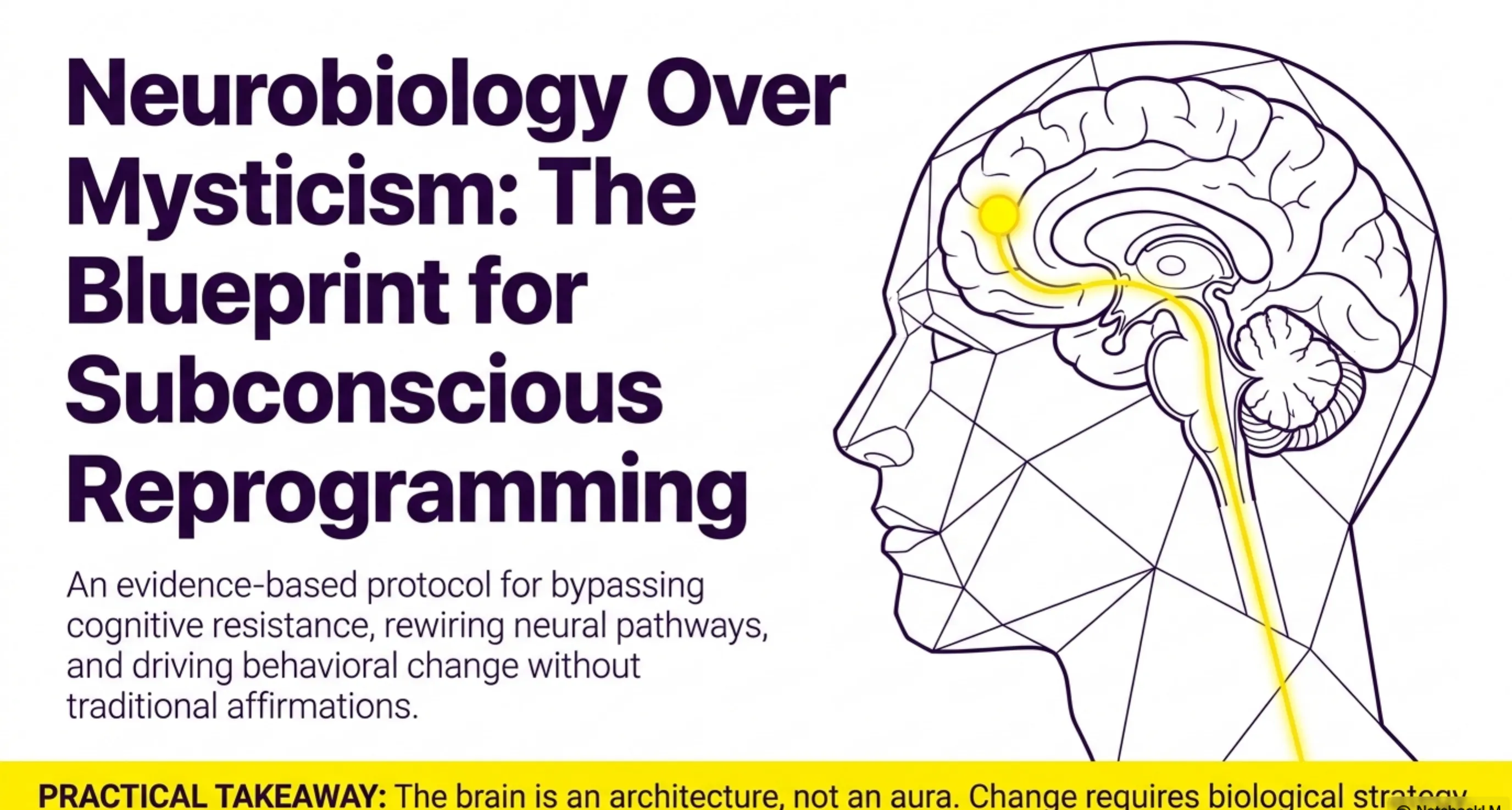
Do Affirmations Actually Work?
Mostly no. Sometimes yes. The honest answer depends on what you mean by "work" and how you define an affirmation.
The 2015 PNAS study by Emily Falk and colleagues found that self-affirmation activated brain regions associated with self-related processing and reward, particularly when paired with future-oriented thinking. The technique can buffer identity threat, improve problem-solving under stress, and reduce defensive responses to health messages.
What it does not do, on the existing research, is rewrite a deeply held subconscious belief through repetition alone.
The popular self-help framing puts a lot of weight on the second claim. The neuroscience puts almost none.
If you have been saying "I am wealthy" or "I am worthy" for months and the underlying feeling has not shifted, you are not failing at the practice. The practice is failing you, because the practice was never built for the layer of mind where the actual pattern lives.
The 95% Problem
Bruce Lipton, the Stanford-trained cell biologist who wrote The Biology of Belief, popularised a framing now replicated across multiple cognitive neuroscience research traditions. Roughly 95% of daily thoughts, feelings, and behaviour are driven by subconscious processing. The conscious mind handles the remaining 5%.
The numbers underneath are computational. Conscious processing handles 40 to 50 bits per second. Subconscious processing handles 11 million bits per second. Anything that needs to happen quickly runs through the subconscious because the conscious mind is too slow.
Most subconscious patterns shaping adult behaviour were installed between the last trimester of pregnancy and age seven. During those years the brain runs predominantly in theta wave state (4 to 8 Hz). Everything experienced during that window writes itself into subconscious patterning without conscious filtering.
By age seven, most people's foundational beliefs about safety, worthiness, belonging, and capability are already laid down. The conscious mind that develops afterward inherits those patterns. It does not get to choose them.
This is the layer affirmations are trying to reach. It is not a layer that responds to conscious-mind input.
Why the Affirmation Fails (And Sometimes Backfires)
Stand in front of a mirror and say "I am worthy of love" out loud. Notice what happens.
If the underlying subconscious belief contradicts the statement, the body tightens. A small voice argues back. The brain registers a mismatch.
That mismatch has a name. Cognitive dissonance.
The brain resolves cognitive dissonance one of three ways. Update the assertion to match the existing belief. Update the existing belief to match the assertion. Or strengthen the existing belief defensively to discredit the assertion.
Standalone affirmations almost always trigger the third path. The conscious mind asserts. The subconscious defends. The defence wins because the subconscious carries 95% of the bandwidth.
Months of daily repetition can reinforce the underlying limiting belief, not erase it. People who report feeling worse after intensive affirmation practice are usually not imagining the effect.
The Three Conditions for Real Subconscious Change
Three things determine whether a new pattern actually writes itself into subconscious memory. All three are required.
Attention. Passive repetition does not write neural pathways. Saying affirmations while making coffee or driving means most of the input never gets registered.
Brainwave state. Beta-state mind (12 to 30 Hz) blocks subconscious updates. The analytical mind sits between the conscious assertion and the subconscious storage layer, and it filters most of what gets through. Theta state (4 to 8 Hz) is the receptive window.
Repetition over time. The 2009 Lally study at University College London found median time to behavioural automaticity was 66 days. Range was 18 to 254 days. Three months is the realistic baseline.
Standard affirmation practice meets the third condition. It rarely meets the first two. That is why the practice tends to feel performative and produce minimal stable change.
Hypnotherapy meets all three by design. EFT meets all three by combining tapping (somatic anchoring), specific phrases (focused attention), and theta-adjacent state (whole-brain integration). Pre-sleep theta-state recordings meet all three.
Theta State: The Real Mechanism for Rewriting Beliefs
Children under seven learn faster than adults because they spend most of their waking hours in theta state. The brain in theta is open. Pattern absorption is the default mode.
Adults reach theta state in five reliable contexts. Deep meditation. Hypnotic induction. The 20 to 30 minutes immediately before sleep. The first few minutes after waking. And during specific physical practices like cross-lateral movement (PSYCH-K) or meridian tapping (EFT) that briefly synchronise the brain hemispheres.
The pre-sleep window is the highest-value one for self-applied work. Recording your own affirmations and listening on quiet playback while falling asleep dramatically outperforms the same affirmations spoken in front of a mirror at 8am. The brain is already in absorption mode. The analytical filter is offline.
The simple version: record yourself saying the new belief in the first person, present tense, with felt emotion. Play it on loop at a low volume from the moment you turn out the light until you fall asleep. Do this nightly for 90 days.
This is not a guarantee. It is a method that meets the brain's actual conditions for change.
Energy Psychology: EFT and the Whole-Brain Window
Energy psychology techniques work through a different mechanism. They use specific physical movements to briefly synchronise the left and right brain hemispheres, creating a whole-brain integration state.
EFT (Emotional Freedom Technique) was developed by Gary Craig in the 1990s. Uses fingertip tapping on acupressure meridian points while voicing a setup statement and reminder phrase. The 2022 Frontiers systematic review by Peta Stapleton and colleagues identified 56 randomised controlled trials. Effect sizes ranged from moderate to large. A representative study showed 24% cortisol reduction in the EFT group versus 14% in supportive interview controls.
EFT is largely self-applicable. Most practitioners can teach the basic protocol in 20 minutes.
PSYCH-K, developed by Rob Williams, uses standing balance postures and specific belief statements to install new beliefs in 5 to 10 minutes. Practitioner-reported outcomes are strong. Formal randomised trials are limited.
Both techniques meet the three conditions for subconscious change in the same session. This is why energy psychology techniques typically outperform standalone affirmation practice.
When Affirmations Actually Help
Affirmations have real value in three specific contexts.
As reinforcement after deeper work. Once a limiting belief has been shifted through hypnotherapy, EFT, consciousness coaching, or somatic experiencing, daily affirmations work well as maintenance.
For surface confidence and performance states. Athletes use affirmations effectively to anchor specific performance states before competition. The mechanism is closer to priming than belief change.
Self-affirmation theory in identity-threat contexts. The Falk 2015 PNAS study and broader social psychology research show self-affirmation reduces defensive responses to threatening health messages, improves problem-solving under stereotype threat, and buffers stress responses. This works because it activates broader self-concept resources, not because it overwrites specific limiting beliefs.
Use affirmations where they work. Switch tools where they do not.
What to Do Instead: A Practical Sequence
If you want to shift a specific limiting belief and ordinary affirmations have failed, here is the sequence with the strongest evidence base.
Step 1. Identify the actual belief, not the symptom. "I cannot launch my business" is a symptom. The belief underneath is usually "if I am visible I will be judged" or "successful people in my family are punished."
Step 2. Start with EFT for emotional charge. The body holds the belief, not just the mind. EFT tapping reduces the somatic charge in 10 to 20 minutes.
Step 3. Add pre-sleep theta-state work. Record the new belief in your own voice, first person, present tense. Play it nightly for 90 days.
Step 4. Pair with cognitive reframing during the day. Standard CBT-style work. Notice the original automatic thought, examine its accuracy, choose a more accurate alternative.
Step 5. Behavioural anchoring. Take small low-stakes actions that contradict the original belief. The brain trusts behavioural evidence over verbal assertion. One small action a day for 90 days outperforms 1,000 mirror affirmations.
Most people skip steps 2, 3, and 5.
The Honest Bottom Line
Affirmations are not useless. They are mismatched to the most common job people are hiring them for.
The mismatch is mechanism. Repeating a sentence in beta state, against a contradicting subconscious belief, in a busy moment of the day, for two or three weeks, will not write a new neural pattern.
What works is the same set of methods proven across the last fifty years of cognitive and clinical research. Theta-state access. Somatic anchoring. Repeated focused attention. Behavioural evidence. Time on task measured in months, not weeks.
If you have been doing affirmations and feeling worse, the failure is structural. Switching tools is the fix.
The methods with the strongest combined evidence and accessibility for self-applied work are: EFT for emotional charge, pre-sleep recorded affirmations for theta-state imprinting, and cognitive reframing for the conscious layer. Layer those for 90 days.
Frequently Asked Questions
If affirmations do not work, why are they so popular?
They feel productive (active practice with no friction). They occasionally help with mild surface confidence patterns. And the self-help industry is built on simple repeatable practices. None of that means they reach the layer where deep limiting beliefs live.
What about visualisation and manifestation practices?
Same problem if practised in beta state. Visualisation done in theta state (during meditation or just before sleep) reaches deeper. The mechanism distinction matters more than the technique.
How long until subconscious reprogramming shows up in behaviour?
Surface habits shift in 30 days. Standard limiting beliefs need 66 to 90 days. Identity-level patterns from early childhood typically need 6 to 18 months across multiple modalities.
Can I do this work on my own or do I need a practitioner?
Surface patterns and habits respond well to self-applied tools (EFT, self-hypnosis recordings, pre-sleep guided imagery, journaling). Identity-level patterns typically need a trained practitioner.
Are there cases where standard affirmations are the right tool?
Yes. After deeper work has shifted the underlying pattern, affirmations work well as maintenance. Athletes use them to anchor performance states. Affirmations reinforce; they rarely install. Use them as the second step, not the first.
Continue Reading
More from the blog
Negative Self-Talk Recode: The Neuroscience of Why Fixing the Inner Critic Backfires
Negative self-talk runs on the Default Mode Network, and Hebbian learning hardwires the loop. Why fighting the inner critic strengthens it, and what a Recode approach does instead.
science-and-evidenceThe Science of Neuroplasticity: Why Your Limiting Beliefs Aren't Permanent
The 2025 ScienceDirect neuroplasticity review. What adult brain plasticity actually shows, why thinking alone produces no change, the 66+ day rewiring timeline, and the role of sleep and stress regulation.
Keep exploring
Browse the rest of NeuralFlow's long-form guides on consciousness coaching, energy healing, and mind-body science. Every article is research-backed and built as a multi-format knowledge hub.
Read more articles