The Science of Neuroplasticity: Why Your Limiting Beliefs Aren't Permanent

Neuroplasticity is the brain's established capacity to form new neural pathways throughout life. The foundational mechanism behind every form of learning and behavioural change. The 2025 ScienceDirect review of neuroplasticity research confirms adult plasticity is real but operates under specific constraints: change requires repeated focused engagement with attention, effort, and feedback (thinking alone does not work), declines measurably after adolescence, and depends on sleep optimisation, stress regulation, and 66+ days of consistent repetition for durable rewiring. Limiting beliefs are not permanent. But they require deliberate practice to change, not just positive thinking.
Key Questions Answered
Is neuroplasticity scientifically real?
Yes. Overwhelmingly. Neuroplasticity is one of the most-replicated findings in modern neuroscience. The 2025 ScienceDirect review documents thousands of studies establishing that the adult brain forms new neural pathways throughout life through a process of synaptic plasticity, structural change, and chemical signalling.
Can the adult brain really change?
Yes, but with caveats. Adult plasticity is real and substantial. Far more than the 20th century neuroscience consensus assumed. However, plasticity declines measurably after adolescence; adult brains require significantly greater repetition and effort than children's brains to form the same new pathway.
Does thinking positive thoughts rewire the brain?
No, not on its own. Recent research clearly shows that thinking without action produces no neural change. The brain requires behavioural evidence, not cognitive intention, to update circuits. Sustainable change needs repeated focused engagement with attention, effort, and feedback over 66+ days.
How long does it take to rewire a limiting belief?
Surface patterns can shift in 30 days of consistent practice. Identity-level limiting beliefs typically need 66 to 90 days of integrated daily work to consolidate new neural pathways. Foundational beliefs from early childhood may require 6 to 18 months of layered work across body, emotion, and cognition.
What practices are backed by neuroscience research?
Strong evidence supports cognitive behavioural therapy, deliberate practice with feedback, mindfulness meditation, somatic experiencing, EMDR, and trauma-informed body work. Weaker evidence. But suggestive. Supports energy psychology techniques like PSYCH-K and EFT. Pure affirmation practice without behavioural component shows minimal evidence.
In This Guide
- What Does Neuroplasticity Actually Mean?
- Can the Adult Brain Really Change?
- How Long Does It Take to Rewire a Limiting Belief?
- What's the Difference Between Thinking and Actually Rewiring?
- What Are the Limits of Adult Neuroplasticity?
- Which Practices Are Backed by Neuroscience Research?
- Why Do Some Beliefs Resist Change Even With Effort?
- How Does Sleep Affect Neural Rewiring?
- What Is the Bottom Line?
Key Takeaways
- The 2025 ScienceDirect review of neuroplasticity research published in Brain Research catalogued thousands of studies confirming adult plasticity as one of the most-replicated findings in modern neuroscience. The question is no longer whether adult brains change, but under what conditions.
- Carol Dweck's research on growth mindset, conducted across multiple decades and replicated in dozens of studies, demonstrates that the belief "the brain can change" itself measurably improves learning outcomes. Fixed mindset is the single largest psychological barrier to neuroplasticity.
- The brain requires three evidence-based conditions for sustainable rewiring: consistent repetition across 66+ days to consolidate new neural pathways, sleep optimisation to trigger synaptic pruning during slow-wave stages, and stress regulation to keep cortisol below levels that suppress hippocampal neurogenesis.
- Hebb's rule from 1949. "neurons that fire together, wire together". Remains the foundational mechanism underneath all forms of brain rewiring; modern neuroscience has refined the rule with details about timing, repetition windows, and the role of glial cells, but the core principle is unchanged.
- Thinking without behavioural action produces measurably zero neural change in fMRI studies; the brain updates through repeated lived experience involving attention, effort, and feedback. Affirmations on their own fail this test, which is why they typically do not produce durable change without paired behaviour.
Listen to the deep-dive on this article
A two-host audio overview of the key ideas. Origins, mechanism, evidence, and what to expect. Useful when you would rather listen than read.
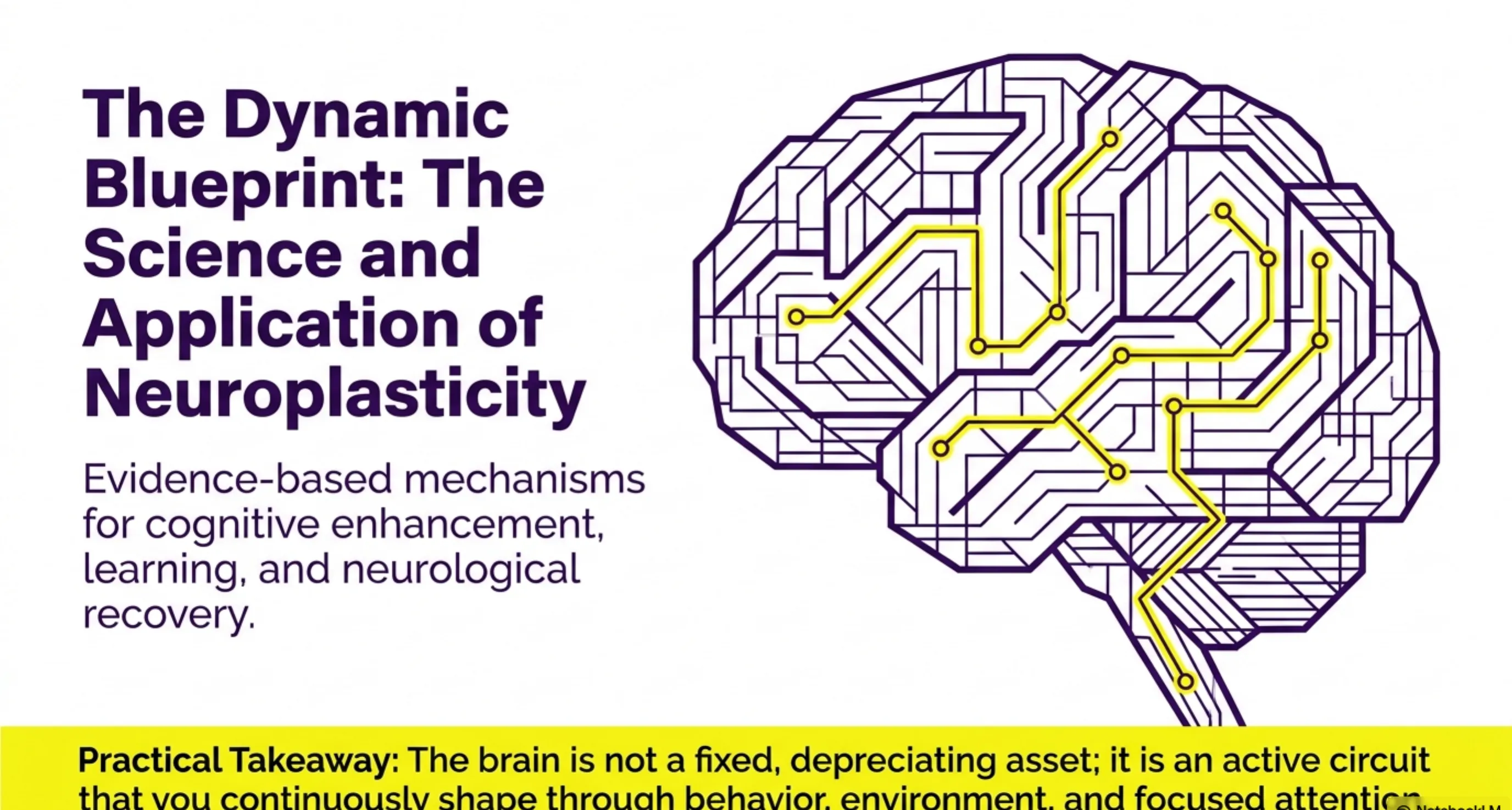
What Does Neuroplasticity Actually Mean?
Neuroplasticity is the brain's capacity to form new neural pathways and reorganise existing ones throughout life in response to experience, learning, and environmental change. It operates at multiple scales. Synaptic, structural, and functional. And is the foundational mechanism behind every form of learning and behavioural change.
The term itself was used cautiously in 20th century neuroscience because the dominant assumption. Through most of that century. Was that the brain became fixed after childhood. Adult brains were thought to lose flexibility once developmental windows closed. Research from the 1990s onward has decisively overturned this view. The 2025 review published in Brain Research catalogues thousands of studies establishing adult plasticity as one of the most-replicated findings in modern neuroscience.
At the cellular level, neuroplasticity involves three mechanisms: synaptic plasticity (changes in the strength and structure of connections between existing neurons), structural plasticity (formation of new dendritic branches and pruning of unused connections), and chemical signalling changes (alterations in neurotransmitter release and receptor sensitivity that change how neurons communicate).
The practical implication: limiting beliefs, behavioural patterns, emotional reactions, and even some physical capacities are not permanent features of who you are. They are patterns the brain has learned, and the same plasticity that installed them allows them to be rewritten. The realistic question is not whether change is possible but under what conditions and over what timeline.
Can the Adult Brain Really Change?
Yes. And the change is more substantial than 20th century neuroscience assumed. But the framing "the brain can change at any age equally" overstates the science.
What the research actually shows: adult plasticity is real and continues throughout life, but declines measurably with age. The 2025 ScienceDirect review documents that critical developmental windows close by early adulthood. The windows that allow children to absorb language patterns effortlessly, develop perfect pitch, or learn motor skills with minimal practice. Adults can still learn these things; it just takes substantially more deliberate practice.
Specifically, adult synaptic rewiring requires:
- Greater repetition. The same change that takes a child 100 exposures may take an adult 1,000
- Greater attention and effort. Passive exposure rarely works for adult brains the way it can for children
- Better recovery conditions. Sleep, stress regulation, and nutrition matter more for adult plasticity than for childhood plasticity
- Feedback loops. Adults need direct feedback to consolidate change, while children pick up patterns implicitly
The encouraging finding: within those constraints, adult plasticity is substantial. Stroke patients regain motor function. Adults learn new languages. Chronic anxiety patterns release with sustained therapy. Limiting beliefs from childhood update with deliberate practice. The 2025 review concludes that "the adult brain maintains substantial plasticity throughout life". The question is no longer whether change is possible but how to use the conditions that make it work.
How Long Does It Take to Rewire a Limiting Belief?
The popular "21 days to a new habit" claim is neuroscience-incorrect. The actual timeline depends on belief depth.
Surface beliefs and habits. 30 days. Habit-level changes (drinking more water, daily walks, basic morning routines) consolidate into automatic behaviour at around 30 days of consistent practice. The original "21 days" research from cosmetic surgery patients in the 1960s was specifically about adapting to physical changes. It has been incorrectly generalised to belief change.
Standard limiting beliefs. 66 to 90 days. The 2009 Lally et al. study at University College London tracked 96 participants forming new behavioural habits and found the median time to automaticity was 66 days, with a range from 18 to 254 days depending on individual and behaviour complexity. This is the realistic baseline for rewiring most limiting beliefs through behavioural practice. Three months of consistent integrated daily work is the minimum useful unit.
Identity-level beliefs. 6 to 18 months. Foundational beliefs ("I am not safe", "I do not belong", "I am fundamentally inadequate") that formed in early childhood under traumatic conditions typically require 6 to 18 months of integrated work across multiple modalities. Somatic, cognitive, and energetic. The longer timeline reflects the depth of the original imprint and the necessity of working through layered protective patterns.
What accelerates the timeline:
- Working with a trained practitioner who can identify underlying belief structure faster than the client typically can in isolation
- Combining cognitive work (CBT, journaling) with body-level work (somatic experiencing, energy healing) and sleep-stage practices (theta-state imprinting)
- Eliminating chronic stressors that suppress plasticity
- Optimising sleep quality (synaptic consolidation happens during slow-wave sleep)
What slows the timeline: chronic high cortisol, alcohol or substance use that disrupts sleep architecture, pure cognitive work without behavioural anchoring, and continued exposure to the original triggering environment.
What's the Difference Between Thinking and Actually Rewiring?
This is one of the most clinically important findings in modern neuroplasticity research, and it directly contradicts most popular self-help framing.
Thinking without action produces measurably zero neural change. fMRI studies comparing participants who only think about a new behaviour versus those who practise the behaviour show neural activation differences only in the practising group. The thinking-only group shows transient activation but no consolidated structural or functional change. This finding has been replicated across multiple research groups.
The brain updates through three specific conditions: repeated exposure, focused attention, and behavioural feedback. All three are required. Two out of three reliably fail.
Repeated exposure alone (passive listening to affirmations during the day) produces minimal change because attention is not engaged. Focused attention alone (intense visualisation without action) produces brief activation but no consolidation. Behavioural feedback alone (acting differently without conscious intent) updates implicit patterns but is harder to direct toward specific changes.
The combination. Repeated focused practice with behavioural feedback over 66+ days. Reliably rewires neural circuits because it satisfies all three conditions the brain requires.
This is why affirmations on their own typically fail: they engage cognitive intention without behavioural feedback. They become more effective when paired with action ("I am healthy" said while taking a daily walk that supports health) or installed at theta brainwave state (just before sleep, during meditation), where the subconscious updates more readily.
This is also why consciousness coaching protocols like Superconscious Recode work: they pair conscious belief choice with theta-state access (so the subconscious updates) and inspired action (so behavioural feedback follows). Single-component approaches consistently underperform integrated ones.
What Are the Limits of Adult Neuroplasticity?
Honest neuroscience acknowledges constraints. The 2025 ScienceDirect review explicitly addresses the limits often overlooked in popular discussions:
Critical developmental windows. Some capacities. Perfect pitch, native-speaker fluency in additional languages, full visual binocularity for amblyopic patients. Depend on neural circuits that form during specific childhood windows. Once those windows close, partial development is still possible but full native-equivalent development is generally not. Adults can become fluent in new languages; achieving accent-free pronunciation after age 12 is rare.
Trauma-induced structural changes. Severe childhood trauma during developmental windows produces structural changes (reduced hippocampal volume, altered amygdala-prefrontal connectivity) that are harder to fully reverse in adulthood. Significant change is still possible. And clinically valuable. But the brain configuration formed under traumatic conditions tends to retain some baseline differences from a non-traumatised brain even after extensive therapeutic work.
Genetic and neurological conditions. Conditions like autism spectrum, ADHD, dyslexia, and bipolar disorder involve genetic and neurological architecture that imposes constraints on what neuroplastic change can achieve. Behavioural and cognitive strategies can substantially improve outcomes within these constraints, but the underlying neurology remains.
Active substance dependencies. The neural patterns of active addiction prevent the kind of plasticity-based change other limiting beliefs respond to. Neuroplasticity-based therapies generally require physical detoxification first; expecting plasticity-based change in someone still actively using is unrealistic.
Chronic high cortisol and inflammation. Chronic stress measurably suppresses hippocampal neurogenesis and reduces overall plasticity. Until the underlying physiological state is regulated, plasticity-based interventions show reduced effectiveness.
Acknowledging these limits is not pessimism. It is the condition for rigorous practice. Within them, the range of changes available to a typical healthy adult brain is substantial, and most common limiting beliefs are well within reach.
Which Practices Are Backed by Neuroscience Research?
Six practices have strong evidence for reliably rewiring limiting beliefs and behavioural patterns through neuroplasticity.
1. Cognitive Behavioural Therapy (CBT). Decades of randomised trial evidence for depression, anxiety, PTSD, and chronic pain. The mechanism is identifying automatic thoughts, examining their accuracy, and reinforcing alternatives through documented practice. The strongest evidence base of any belief-change intervention.
2. Deliberate practice with feedback. Anders Ericsson's research established the neuroscience underneath skill development. Focused practice on specific weakness, immediate feedback, and gradual difficulty progression. Translates directly to belief change when applied behaviourally.
3. Mindfulness and meditation. 8-week MBSR programmes produce measurable functional changes (reduced amygdala reactivity, improved prefrontal regulation). Long-term practice (1,000+ hours) produces structural changes including increased grey matter density in regulatory regions.
4. Somatic experiencing and trauma-informed body work. Direct engagement of the autonomic nervous system updates patterns held below the level of language. Strong evidence for trauma-rooted patterns; supports cognitive change by making the body physically capable of holding new patterns.
5. EMDR (Eye Movement Desensitisation and Reprocessing). Originally for PTSD; demonstrated efficacy for trauma-rooted limiting beliefs and chronic pain. The mechanism appears to involve facilitated reprocessing of stuck memory networks.
6. Sleep-stage interventions. Synaptic consolidation happens during slow-wave sleep. Practices that optimise sleep quality (consistent timing, dark cool environment, minimal alcohol, theta-state recordings before sleep) measurably improve neuroplasticity outcomes from any other intervention.
Practices with weaker but suggestive evidence include energy psychology techniques (PSYCH-K, EFT) and consciousness coaching protocols. The biological mechanisms underneath are plausible. They engage attention, theta-state access, and somatic anchoring. But rigorous randomised trials of specific protocols are limited. Practitioner-reported outcomes are strong; controlled trial evidence is partial.
Practices with minimal supporting evidence: pure affirmation practice without behavioural component, generic positive thinking, and willpower-based behaviour change without underlying belief work.
Why Do Some Beliefs Resist Change Even With Effort?
Some limiting beliefs persist despite consistent effort, and the neuroscience explains why. And what to do about it.
1. The belief is structurally protective. Subconscious patterns often defend the organism. A belief like "I am not worthy of love" may have formed in childhood as a way to make sense of inconsistent caregiving. Believing the problem was internal allowed the child to maintain the relationship by avoiding triggering parental discomfort. Twenty years later, the conscious mind wants the belief gone, but the subconscious still treats it as protective. Direct conscious challenge can intensify the protection.
Solution: Work with a practitioner trained to address protective belief structures. Direct CBT-style cognitive challenge often fails on protective beliefs; consciousness coaching, somatic experiencing, and parts-work approaches engage the protection rather than fight it.
2. The body still reinforces the belief. If the body remains in chronic sympathetic activation, the cognitive belief that "I am safe" will not consolidate because the body continues to send threat signals. The brain trusts body data over conscious assertion.
Solution: Combine cognitive work with daily nervous system regulation. Yoga, breathwork, time in nature, social connection with safe people. The body needs to feel safe before the brain accepts that safety is true.
3. The environment reinforces the original pattern. If you are trying to update "I am not respected" while continuing to work in an environment that does not respect you, the brain receives daily evidence that the original belief is accurate. Plasticity follows lived experience; lived experience needs to change.
Solution: Reduce exposure to environments that reinforce the original pattern, or change the environment's structure (clearer boundaries, different relational context, role change).
4. Sleep and stress are sabotaging consolidation. Chronic high cortisol and disrupted sleep architecture prevent the synaptic consolidation that durable change requires. The cognitive work is happening; the consolidation is not.
Solution: Address sleep and stress as foundational. No amount of cognitive intervention will consolidate change in a chronically dysregulated body.
For people who have tried multiple approaches without resolution, the issue is rarely that change is impossible. It is usually that one or more of these factors is silently blocking consolidation. A practitioner trained in consciousness coaching can typically identify which factor is the actual barrier within one or two sessions.
How Does Sleep Affect Neural Rewiring?
Sleep is not separate from neuroplasticity. It is integral to it. Most synaptic consolidation happens during sleep, not during waking practice.
The mechanism: during slow-wave sleep (stages 3 and 4), the brain replays the day's significant patterns at accelerated speed, strengthening connections that match meaningful experience and pruning connections that did not. Without adequate slow-wave sleep, the patterns you practised during the day fail to consolidate into durable neural change. You repeat the same conscious effort the next day with no compounding benefit.
Practical implications:
Sleep duration matters. Adults need 7 to 9 hours for full sleep architecture; the final two REM cycles (which happen in the second half of the night) are particularly important for emotional and belief consolidation. Cutting sleep short systematically eliminates these cycles.
Sleep timing matters. Slow-wave sleep is most abundant in the first half of the night. Going to bed at a consistent time before 11pm aligns sleep architecture with circadian biology and produces measurably more slow-wave sleep than later bedtimes.
Alcohol disrupts the architecture. Alcohol. Even moderate consumption. Suppresses REM sleep and disrupts slow-wave sleep cycles. People drinking alcohol regularly often experience seven to eight hours of low-quality sleep that produces less consolidation than five hours of unimpaired sleep would.
Pre-sleep theta-state work pays back. The 20 to 30 minutes before sleep is a natural theta-state window. New belief statements, recorded affirmations, or guided meditations during this window are absorbed at a deeper level than the same input during the day. Bruce Lipton specifically recommends this approach for subconscious reprogramming, and the neuroscience underneath supports it.
Stress and cortisol disrupt consolidation. Chronic stress reduces slow-wave sleep and increases nighttime cortisol. Both of which suppress the synaptic consolidation that durable change requires. Stress regulation during the day directly improves neuroplasticity outcomes.
For someone serious about rewiring limiting beliefs, sleep optimisation often produces greater effect than any specific cognitive intervention. The intervention works during the day; the consolidation works at night.
What Is the Bottom Line?
Neuroplasticity is real, established, and substantial. But it is not magic. The adult brain forms new neural pathways throughout life through synaptic plasticity, structural change, and chemical signalling, and this is the foundational mechanism that allows limiting beliefs to be rewired. The 2025 ScienceDirect review confirms decades of replicated research: change is possible at any age.
The realistic frame is more demanding than popular media suggests. Thinking does not rewire the brain. Action with attention, repetition, and feedback does. Surface patterns shift in 30 days; standard limiting beliefs need 66 to 90 days; identity-level beliefs need 6 to 18 months of integrated work across body, cognition, and emotion. Sleep optimisation, stress regulation, and environmental support all matter more than most popular self-help framings suggest.
For someone wanting to rewire specific limiting beliefs, the most efficient pathway combines: (1) cognitive identification of the specific belief, (2) deliberate behavioural practice that contradicts the belief in low-stakes situations, (3) body-level regulation (yoga, breath, time in nature) to keep the nervous system capable of holding the new pattern, (4) pre-sleep theta-state reinforcement, and (5) consistent practice over at least 66 days.
For deeper or stuck patterns, working with a practitioner trained in consciousness coaching or body-first modalities typically resolves in weeks what isolated self-practice may take months or years to address. certified practitioners combine 2-Point Healing for the body layer with the Superconscious Recode protocol for the belief and identity layer. The integrated approach addresses all three of the brain's consolidation conditions in one structured session. A 1-on-1 session is priced competitively (typical range $100–200 USD per session), worldwide via Zoom.
Your limiting beliefs are not permanent. They are patterns the brain has learned, and the same plasticity that installed them is available to rewrite them. Under the right conditions, with consistent practice, over a realistic timeline.
Frequently Asked Questions
Why does popular media exaggerate neuroplasticity?
Two reasons: it is a hopeful message that sells books and courses, and the underlying science is genuinely encouraging. The exaggeration usually involves three claims that are not quite accurate. First, "the brain can change at any age equally". False, plasticity declines measurably after adolescence. Second, "you can rewire your brain in 21 days". False, durable rewiring typically requires 66 to 90 days minimum. Third, "thinking new thoughts rewires the brain". False, behavioural action with feedback is required. The 2025 ScienceDirect review explicitly addresses these inflations and provides the realistic frame: plasticity is real but operates under specific conditions and constraints.
How is neuroplasticity different from neurogenesis?
Neuroplasticity refers to changes in synaptic structure and connection patterns between existing neurons. Strengthening, weakening, or reorganising connections. Neurogenesis specifically refers to the creation of new neurons, which happens primarily in the hippocampus throughout adult life and at smaller rates in the olfactory bulb. Both contribute to brain change, but neuroplasticity is the larger and faster mechanism for behavioural and belief change. Most "rewiring your brain" claims are about neuroplasticity, not neurogenesis.
Are there limits to what neuroplasticity can change?
Yes. And being honest about these limits is part of rigorous neuroscience. Severe early childhood trauma during critical developmental windows produces structural changes that are harder to fully reverse in adulthood. Some genetic conditions, neurological injuries, and degenerative diseases impose limits regardless of practice. Substance dependencies create patterns that require physical detoxification before neuroplasticity-based change becomes possible. Within these constraints, however, the range of changes available to a healthy adult brain is substantial. Most popular limiting beliefs are well within the range of what consistent practice can rewire.
Does meditation actually change the brain?
Yes, with caveats. Long-term meditation practice (1,000+ hours over multiple years) produces measurable structural changes in the brain. Increased grey matter density in the prefrontal cortex and hippocampus, reduced amygdala volume, and improved interhemispheric connectivity. These changes have been replicated in multiple imaging studies. Short-term meditation practice (8 weeks of MBSR) produces functional changes (improved emotional regulation, reduced stress response) but smaller structural changes. The benefits are real and progressive. Early practice produces large functional benefits that gradually become structural with sustained practice.
What is the most efficient way to rewire a specific limiting belief?
Combination approaches consistently outperform any single technique. The most efficient pattern: identify the specific belief and the situations that trigger it; choose a more accurate alternative belief; pair the alternative with deliberate behavioural practice (acting as if the alternative is true) in low-stakes situations; reinforce nightly with a body-anchored practice (theta-state guided imagery, paired meditation, or recorded affirmation listened to at sleep onset); maintain for at least 66 days. For deeper identity-level beliefs, working with a practitioner trained in consciousness coaching (such as <a href="/what-is-superconscious-recode">Magnetic Mind Superconscious Recode</a>) accelerates the timeline significantly because the practitioner can identify the underlying belief structure faster than the client typically can in isolation.
Continue Reading
More from the blog
The Mind-Body Connection: How Your Thoughts Are Making Your Chronic Pain Worse
Mind-body neuroscience for chronic pain. Bessel van der Kolk's research on trauma reshaping brain structure, why willpower fails, and which body-first treatments (somatic experiencing, EMDR, energy healing) actually work.
mindset-transformationWhy Affirmations Don't Work (And What Actually Changes Subconscious Beliefs)
The science behind why affirmations fail and what modalities actually rewire subconscious patterns.
mindset-transformationNegative Self-Talk Recode: The Neuroscience of Why Fixing the Inner Critic Backfires
Negative self-talk runs on the Default Mode Network, and Hebbian learning hardwires the loop. Why fighting the inner critic strengthens it, and what a Recode approach does instead.
mindset-transformationHow to Reprogram Your Subconscious Mind for Healing
Reprogramming the subconscious. Bruce Lipton's 5%/95% framework, the neuroscience of why affirmations alone fail, evidence-based techniques (hypnotherapy, PSYCH-K, EFT, Superconscious Recode), and realistic timelines for change.
Keep exploring
Browse the rest of NeuralFlow's long-form guides on consciousness coaching, energy healing, and mind-body science. Every article is research-backed and built as a multi-format knowledge hub.
Read more articles