How to Reprogram Your Subconscious Mind for Healing

Reprogramming the subconscious mind for healing means changing the automatic patterns that drive 95% of daily thoughts, feelings, and behaviour. Patterns formed mostly between birth and age seven. Effective methods bypass the analytical conscious mind to directly access the subconscious layer: hypnotherapy, theta-state imprinting (4–8 Hz brainwave states), energy psychology (PSYCH-K, EFT), repeated cognitive reframing, and consciousness coaching protocols like the Magnetic Mind Method Superconscious Recode. Most patterns shift over 1 to 3 sessions plus 30 to 90 days of integration; some need ongoing reinforcement.
Key Questions Answered
Can you actually reprogram the subconscious mind?
Yes. And the neuroscience is well-established. Neuroplasticity research confirms the adult brain forms new neural pathways through repeated focused experience. The subconscious is not fixed; it is constantly updating based on emotional intensity and repetition. Targeted methods accelerate this update.
Why do affirmations on their own usually fail?
Affirmations engage the conscious mind but the subconscious only updates through emotion, repetition, and altered brainwave states. Saying "I am worthy" while subconsciously believing the opposite creates internal conflict, not change. Effective reprogramming pairs the new belief with theta-state access.
What is the most effective method?
No single method is best for everyone. Hypnotherapy works well for habit-driven patterns. Energy psychology (PSYCH-K, EFT) suits emotionally charged patterns. Consciousness coaching like Superconscious Recode suits identity-level patterns. Combination approaches outperform any single method for complex chronic patterns.
How long does subconscious reprogramming take?
Single specific patterns can shift in one focused session. Layered chronic patterns typically need 3 to 8 sessions over 2 to 4 months. Foundational identity-level patterns ("I am not worthy") may need 6 to 12 months of integrated work plus ongoing reinforcement.
How do you know it is actually working?
You notice automatic responses changing without effort. Old triggers stop activating the old reaction. Behaviour you previously had to force now happens naturally. Body symptoms tied to subconscious stress (chronic tension, sleep issues, gut symptoms) reduce. Other people often notice changes before you do.
In This Guide
- Can You Actually Reprogram Your Subconscious Mind?
- Why 95% of Your Behaviour Comes from the Subconscious
- How Does Subconscious Reprogramming Work in the Brain?
- What Techniques Actually Reprogram the Subconscious?
- Why Affirmations Alone Often Fail
- What Role Does Energy Psychology Play?
- How Long Does Subconscious Reprogramming Take?
- How Do You Know It Is Actually Working?
- What Is the Bottom Line?
Key Takeaways
- Cognitive neuroscience research estimates that approximately 95% of daily thoughts, feelings, and behaviour are driven by subconscious patterning. Most of it formed between the last trimester of pregnancy and age seven.
- Bruce Lipton, Stanford-trained cell biologist, identifies three evidence-based mechanisms for reprogramming the subconscious: hypnosis (theta-state access), repetition (Hebbian learning), and energy psychology (whole-brain integration).
- Theta brainwave state (4–8 Hz) is the natural learning state of children under age seven and the access point most reprogramming methods deliberately recreate. It is reachable in adulthood through hypnotic induction, deep meditation, and consciousness coaching protocols.
- PSYCH-K, developed by Rob Williams, uses simple physical movements to engage whole-brain (left-right hemisphere) integration; this state allows new belief statements to bypass conscious resistance and write directly to the subconscious in a 5 to 10 minute window.
- The Magnetic Mind Method Superconscious Recode uses a structured 5-step protocol. Choose end result, establish structural tension, connect to superconscious field, recode command, inspired action. That combines theta access, conscious choice, and somatic anchoring to reprogram identity-level patterns.
Listen to the deep-dive on this article
A two-host audio overview of the key ideas. Origins, mechanism, evidence, and what to expect. Useful when you would rather listen than read.
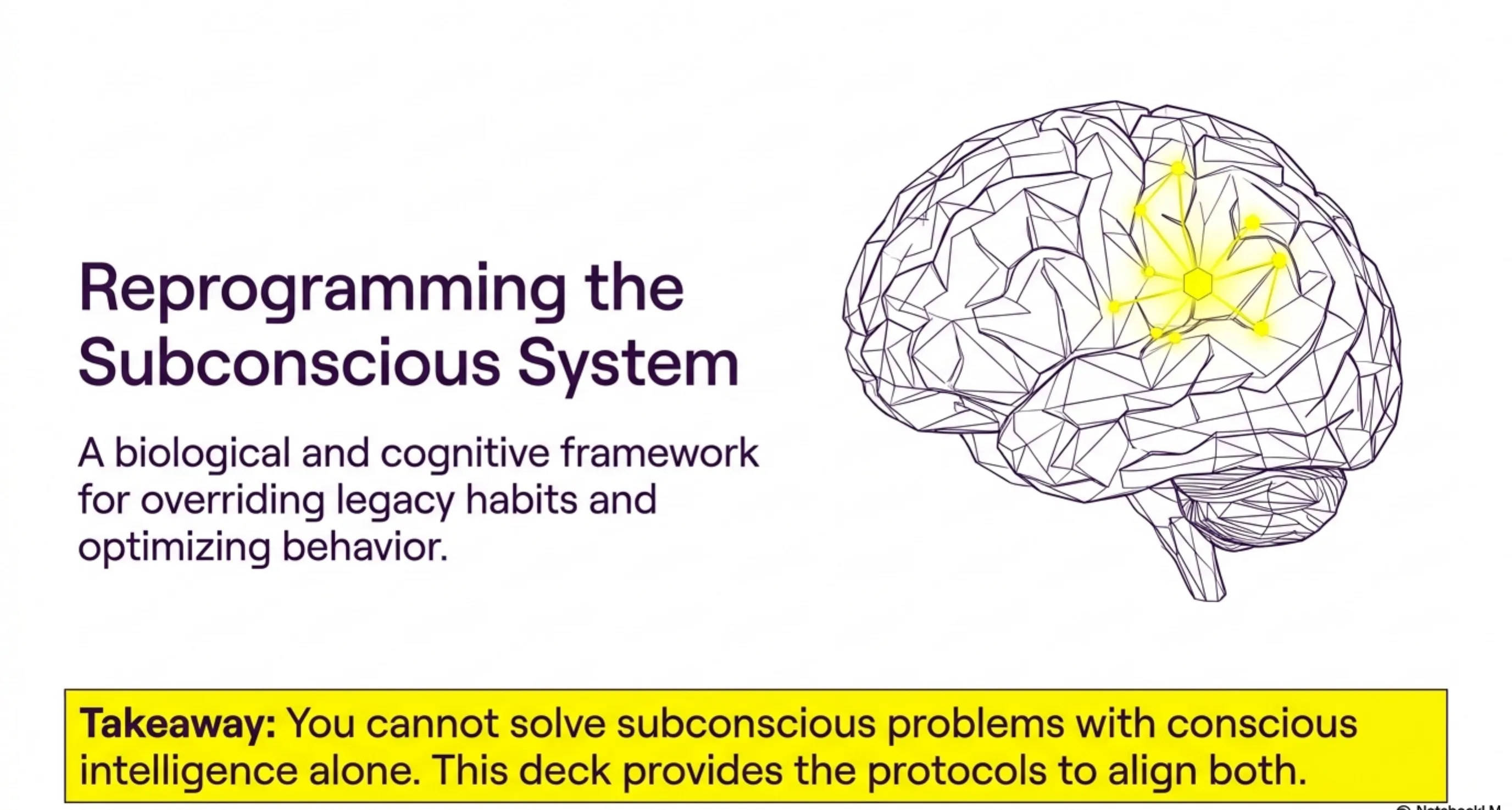
Can You Actually Reprogram Your Subconscious Mind?
Yes. And the neuroscience supporting this is well-established. The adult brain forms new neural pathways throughout life through a process called neuroplasticity, and the subconscious is part of that adaptive system. The subconscious is not a fixed file from childhood; it is a constantly updating predictive model of the world.
What confuses people is the speed of update. Conscious learning is fast. You can absorb a new idea in seconds. Subconscious learning is slow. It requires repetition, emotional intensity, or specific brainwave states to write new patterns. Most people try to update their subconscious using conscious-mind methods (affirmations, willpower, positive thinking) and conclude it does not work because the change does not stick.
Effective subconscious reprogramming uses methods designed for how the subconscious actually updates: theta-state access, repetition with emotional charge, somatic engagement, and whole-brain integration. These are not mystical concepts. They are the conditions under which the brain forms durable new neural pathways, established through 30+ years of neuroscience research.
The practitioners who do this work. Hypnotherapists, energy psychologists, consciousness coaches, somatic experiencing practitioners. Use different protocols but target the same underlying neural mechanism: changing how the brain automatically predicts and responds before conscious thought engages.
Why 95% of Your Behaviour Comes from the Subconscious
Cognitive neuroscience estimates that approximately 95% of daily thoughts, feelings, and behaviour are driven by subconscious processing. Stanford-trained cell biologist Bruce Lipton popularised this 5%/95% framing in his book "The Biology of Belief". The figure has since been validated across multiple research traditions, with various studies estimating subconscious processing at 90% to 99% of total cognition.
The reason this proportion exists is computational. The conscious mind processes around 40 to 50 bits of information per second. The subconscious processes around 11 million bits per second. Anything that needs to happen quickly. Driving, walking, reacting to facial expressions, regulating heart rate, choosing words in conversation. Runs through the subconscious because the conscious mind is too slow.
The catch: most subconscious patterns were installed between the last trimester of pregnancy and age seven, when the brain runs predominantly in theta wave state (4 to 8 Hz). During those years, the brain absorbs everything experienced. Parental words, emotional climate, repeated interactions, traumatic events. As foundational patterning without conscious filtering. By age seven, the patterns that drive most adult behaviour are already in place.
This is why Superconscious Recode work begins with identifying the specific sabotaging belief from childhood. The pattern is rarely about the current situation; it is the childhood pattern still running in the present.
How Does Subconscious Reprogramming Work in the Brain?
Subconscious reprogramming works through three intertwined neural mechanisms: synaptic plasticity, brainwave state modulation, and somatic anchoring.
Synaptic plasticity (Hebb's rule). "Neurons that fire together, wire together." When you repeatedly activate a new pattern alongside the old one, the new neural pathway strengthens while the old one weakens. The change is biological. Synaptic structures physically reorganise. This is the mechanism behind every form of learning, from riding a bike to changing a belief.
Brainwave state modulation. The adult brain spends most waking time in beta wave state (12 to 30 Hz). Alert, analytical, conscious-mind-dominant. Beta is poor for subconscious reprogramming because the analytical mind blocks new patterns from writing. Theta state (4 to 8 Hz). Naturally accessed during deep meditation, hypnotic induction, dream sleep, and certain physical practices. Opens the subconscious to new programming. Most reprogramming methods deliberately induce theta access for this reason.
Somatic anchoring. Patterns held only in the mind drift; patterns anchored in the body persist. Effective reprogramming methods include physical movement, breathwork, touch points, or postural changes that link the new pattern to a physical sensation. The body becomes a reminder of the new pattern, reinforcing it across days and weeks.
The practitioners who consistently produce durable change combine all three mechanisms. The methods that fail typically miss one. Pure cognitive reframing without theta access produces understanding without behavioural change; pure relaxation without conscious choice produces calm without direction.
What Techniques Actually Reprogram the Subconscious?
Five evidence-based techniques reliably reprogram subconscious patterns when applied correctly.
Hypnotherapy. Induced theta state via verbal guidance allows direct suggestion to the subconscious mind. Best for habit-level patterns (smoking, eating, sleep, phobias) and trauma-related patterns. Typical session is 60 to 90 minutes; 3 to 6 sessions for stable change. Bruce Lipton calls hypnosis "the most direct method" for subconscious access.
Energy psychology (PSYCH-K and EFT). Combines physical movement (tapping, cross-lateral motion) with focused intention to engage whole-brain integration. The brain enters a brief receptive state. Lipton calls it "superlearning". During which new beliefs can be installed in 5 to 10 minutes. Best for emotionally charged patterns and beliefs about self-worth.
Consciousness coaching (Superconscious Recode). Christopher Duncan's Magnetic Mind Method uses a 5-step protocol to access the superconscious state. A level of awareness above ordinary conscious and subconscious. And from that state recode identity-level patterns. The client stays alert and verbal throughout. Best for foundational sabotaging beliefs ("I am not enough", "I do not belong") that drive multiple symptoms across life domains. certified practitioners deliver this work worldwide. See the full Superconscious Recode guide.
Cognitive reframing with repetition. The core technique inside cognitive behavioural therapy. Identify the automatic thought, examine its accuracy, choose a more accurate alternative, and reinforce that alternative through documented daily practice for 30 to 90 days. Strong evidence base from clinical psychology research. Best for explicit thought patterns (catastrophising, all-or-nothing thinking).
Somatic experiencing and trauma-informed embodied work. Developed by Peter Levine. Tracks where stuck patterns live in the body and uses titrated physical attention to release them. Best for trauma-rooted patterns and chronic physical symptoms tied to unprocessed emotional experience. Works in tandem well with the techniques above.
Why Affirmations Alone Often Fail
Affirmations are not useless. But on their own, they fail more often than they work, and the neuroscience explains exactly why.
Affirmations engage the conscious mind, not the subconscious. When you say "I am worthy" with your conscious analytical mind in beta state, you are talking to the 5% of cognition. The 95% subconscious layer. Which holds the contradicting belief. Does not even hear it as relevant input. The affirmation rolls past the layer that needs to change.
Worse: affirmations can amplify the conflict. If you subconsciously believe "I am not worthy" and consciously declare "I am worthy", the gap between these two states triggers internal stress. Your subconscious notices the conscious lie and doubles down on the underlying belief as protective truth. Some people end up feeling worse after months of affirmation practice than they did before starting.
Bruce Lipton's research distinguishes between effective and ineffective affirmation use. Effective: spoken in theta state (just before sleep, during meditation, while listening to focused music), present tense ("I am healthy" not "I will be healthy"), paired with felt body sensation. Ineffective: spoken in beta state during the day, future tense, said while consciously feeling the opposite.
The practical fix is not to abandon affirmations but to install them at the right brainwave state. Recording your own affirmations and listening at sleep onset, pairing affirmations with PSYCH-K or EFT physical movements, or working with a practitioner who delivers them during hypnotic induction all multiply effectiveness.
What Role Does Energy Psychology Play?
Energy psychology. The umbrella for techniques like PSYCH-K, EFT (Emotional Freedom Technique), Tapas Acupressure Technique, and 2-Point Healing. Sits in a specific niche: fast access to subconscious change for emotionally charged patterns.
The mechanism is whole-brain integration. The left brain (analytical, sequential, language-dominant) and right brain (intuitive, holistic, emotional) usually process information slightly out of phase. Physical movements like cross-lateral tapping, eye movements, or specific postural patterns synchronise the hemispheres briefly, creating a window. Bruce Lipton calls it "superlearning". During which the brain accepts new programming faster than usual.
PSYCH-K specifically uses standing postures, balance points, and focused belief statements to install new beliefs in 5 to 10 minutes. Practitioners report success rates above 80% for the specific pattern targeted, though formal randomised trials are limited.
EFT (tapping) uses fingertip tapping on acupressure meridian points while voicing a setup statement and reminder phrase. Strong evidence base for trauma-related anxiety. Multiple studies show EFT reducing PTSD symptoms comparable to evidence-based therapies, with the advantage that clients can self-apply between sessions.
2-Point Healing. The modality practitioners practise. Works similarly through simultaneous touch at two specific body points, creating an energetic bridge that releases stored emotional patterning. See the full 2-Point Healing guide for the mechanism.
Energy psychology is most powerful when combined with consciousness coaching for deeper identity work and with somatic experiencing for trauma integration. Used in isolation it works well for surface patterns but tends to plateau on identity-level beliefs.
How Long Does Subconscious Reprogramming Take?
Realistic timelines vary by pattern depth.
Single specific patterns. 1 to 3 sessions over 2 to 6 weeks. Habit-level patterns (smoking, nail biting, food cravings, specific phobias) often release in a single focused session and stabilise over 30 to 60 days of integration. The Magnetic Mind Superconscious Recode typically resolves a single sabotaging belief in one 60-minute session, with behavioural change integrating over the following 1 to 3 days.
Layered chronic patterns. 3 to 8 sessions over 2 to 4 months. Patterns that drive multiple symptoms across life domains (chronic anxiety, low self-worth affecting work and relationships, perfectionism) typically need several sessions because each session releases one layer and reveals the next. Most clients see 60 to 80% improvement by session 4 with full stabilisation around session 8.
Foundational identity-level patterns. 6 to 12 months of integrated work. Foundational patterns ("I am not safe", "I do not belong", "I am fundamentally flawed") that formed in early childhood under traumatic conditions typically need ongoing work over 6 to 12 months and benefit from combining multiple modalities. Consciousness coaching for the cognitive/identity layer, somatic experiencing for the body layer, and EFT or PSYCH-K for emotional charge regulation. Real change here is durable but slow.
The key indicator is spontaneous behaviour change without conscious effort. If you find yourself doing the new pattern automatically, without having to remind yourself, the subconscious has updated. If the new pattern still requires daily willpower 60 days in, the underlying belief has not yet shifted.
How Do You Know It Is Actually Working?
Five signs distinguish real subconscious change from temporary mood lift.
1. Automatic responses change. Old triggers stop firing the old reaction. The colleague's tone that used to make you defensive now lands neutrally. The situation that used to trigger anxiety now reads as just information. You notice the change because you did not have to do anything. The response simply stopped happening.
2. Behaviour you previously had to force now happens naturally. The boundary you used to white-knuckle now sets itself. The work session you used to procrastinate on starts on time. The conversation you used to avoid now feels neutral. The hallmark of subconscious change is the absence of effort.
3. Body symptoms reduce. Patterns held subconsciously often manifest physically. Chronic shoulder tension, jaw clenching, gut symptoms, sleep disruption, recurring headaches. When the underlying pattern releases, the somatic symptoms reduce or resolve. This is why certified practitioners combine 2-Point Healing for the body layer with Superconscious Recode for the belief layer. Body and belief track each other closely.
4. Other people notice before you do. Subconscious change is invisible from the inside because it is the absence of patterns that used to be there. Family members, partners, and close colleagues often comment on changes. "you seem different", "you haven't done X in a while". Before you have noticed yourself.
5. The pattern does not return under stress. The real test is what happens when you are tired, sick, under deadline, or in conflict. Surface change collapses under stress and the old pattern reappears. Genuine subconscious change holds. Even under load, the new pattern stays the default.
What Is the Bottom Line?
Reprogramming the subconscious mind is not mystical. It is the deliberate use of neuroplasticity, brainwave state modulation, and somatic anchoring to update the 95% of cognition that runs your default behaviour. The science underneath is well-established. The methods that work are evidence-based. The timelines are realistic.
For surface patterns and habits, self-applied energy psychology (EFT, PSYCH-K) and self-hypnosis recordings produce real change in 4 to 12 weeks. For identity-level patterns, working with a trained practitioner is faster and more durable. The subconscious tends to defend its organising beliefs against direct conscious challenge, and a skilled practitioner can see and address what the client cannot see in themselves.
The Magnetic Mind Superconscious Recode is one of the most efficient protocols for identity-level work. A structured 5-step process that resolves a single sabotaging belief in 60 minutes and stabilises over 1 to 3 days. certified practitioners deliver this work worldwide. A 1-on-1 session is priced competitively (typical range $100–200 USD per session).
For people working primarily on themselves, low-cost foundational programmes offered by Magnetic Mind certified practitioners provide structured self-applied tools including audio meditations, the Magic Ball Process, and workbooks for identifying and recoding sabotaging beliefs. Most clients combine a starter programme with 2 or 3 1-on-1 sessions across the first 6 months. The combination is more cost-effective than session-only work.
Frequently Asked Questions
Is subconscious reprogramming the same as positive thinking?
No. Positive thinking operates at the conscious surface. The 5% of mental activity. Subconscious reprogramming targets the 95% layer underneath, where the actual patterns live. Positive thinking on top of an unchanged subconscious creates chronic internal conflict (consciously trying to be optimistic while subconsciously believing the worst will happen). Real reprogramming changes the underlying pattern so the new behaviour requires no effort to maintain.
Do I have to be hypnotised for it to work?
No. Hypnosis is one effective access method but not the only one. Energy psychology (PSYCH-K, EFT) works in normal alert consciousness using physical movements and tapping. Consciousness coaching protocols like Superconscious Recode keep the client fully alert with eyes open. Deep meditation, theta-state guided imagery, and somatic experiencing all access the same neural state without formal hypnotic induction.
Will it work if I am sceptical of the technique?
Yes. Often surprisingly well. Most reprogramming methods bypass the conscious analytical mind, which is where scepticism lives. What you need is willingness to follow the practitioner's prompts honestly and engage with the pattern you want to address. Many of the strongest results come from clients who arrived deeply doubtful. Belief in the method is not a prerequisite; willingness to engage with the work is.
Can I reprogram my own subconscious without a practitioner?
Some methods are explicitly self-applied. PSYCH-K, EFT, self-hypnosis recordings, structured journaling, meditation practices. These work well for surface patterns and habit-level changes. Identity-level patterns (I am not worthy, I do not belong, I am not capable) benefit substantially from a trained practitioner because the subconscious tends to defend its own organising beliefs against direct conscious challenge. The practitioner sees patterns the client cannot see in themselves.
Is there scientific evidence for subconscious reprogramming?
Two underlying mechanisms are well-established. First, neuroplasticity. The brain's capacity to form new neural pathways through repeated experience. Has decades of cellular and behavioural evidence. Second, cognitive reframing (a core component of cognitive behavioural therapy) has substantial randomised trial evidence for reducing depression, anxiety, and PTSD symptoms. Specific methods like PSYCH-K and Superconscious Recode have not been studied in large randomised trials, so practitioners report client outcomes as observed rather than clinically proven. The biological mechanisms underneath are real; the specific protocols vary in how directly they have been studied.
Continue Reading
More from the blog
Negative Self-Talk Recode: The Neuroscience of Why Fixing the Inner Critic Backfires
Negative self-talk runs on the Default Mode Network, and Hebbian learning hardwires the loop. Why fighting the inner critic strengthens it, and what a Recode approach does instead.
science-and-evidenceThe Science of Neuroplasticity: Why Your Limiting Beliefs Aren't Permanent
The 2025 ScienceDirect neuroplasticity review. What adult brain plasticity actually shows, why thinking alone produces no change, the 66+ day rewiring timeline, and the role of sleep and stress regulation.
pain-and-healingThe Mind-Body Connection: How Your Thoughts Are Making Your Chronic Pain Worse
Mind-body neuroscience for chronic pain. Bessel van der Kolk's research on trauma reshaping brain structure, why willpower fails, and which body-first treatments (somatic experiencing, EMDR, energy healing) actually work.
Keep exploring
Browse the rest of NeuralFlow's long-form guides on consciousness coaching, energy healing, and mind-body science. Every article is research-backed and built as a multi-format knowledge hub.
Read more articles