What Is a Superconscious Recode Session? Everything You Need to Know

A Superconscious Recode session is a 60-minute consciousness coaching technique developed by Christopher Duncan as part of the Magnetic Mind Method. Through a structured five-step process, the practitioner helps you identify a sabotaging subconscious belief, access the superconscious state, and recode the pattern at the level it formed. Typically childhood. Sessions are delivered in person or via Zoom, and clients commonly report measurable shifts in mood, decision-making, and physical symptoms within hours of the session.
Key Questions Answered
What is a Superconscious Recode session?
A Superconscious Recode session is a 60-minute consciousness coaching technique that uses a five-step process to clear a sabotaging subconscious belief and replace it with a chosen new pattern at the superconscious level of awareness.
Who created the Superconscious Recode?
Christopher Duncan, founder of Magnetic Mind and author of the 2021 book "You're Not Broken: 5 Steps to Become Superconscious and Activate Your Magic," developed the Superconscious Recode in 2019 as the core process of the Magnetic Mind Method.
How is Superconscious Recode different from talk therapy?
Talk therapy works mostly through conscious analysis and verbal processing. Superconscious Recode bypasses the analytical mind to address the subconscious belief that drives the symptom. Typically resolving the loop in one session rather than over months.
Does Superconscious Recode work over Zoom?
Yes. Magnetic Mind certified practitioners deliver the full Recode process via Zoom worldwide. The technique works through guided focus and consciousness. Physical proximity is not required for the process to take effect.
How quickly do clients notice changes?
Many clients describe a noticeable internal shift during the session itself. A felt release of the limiting pattern. Behavioural and emotional changes typically begin within 24 to 72 hours as the new neural pathway integrates.
In This Guide
- What Is a Superconscious Recode Session?
- How Does the Rapid Recode Process Work Step by Step?
- Where Does Superconscious Recode Come From?
- What Is the Science Behind Subconscious Reprogramming?
- How Is Superconscious Recode Different from Other Approaches?
- What Happens in a 60-Minute Session?
- Who Is Superconscious Recode Right For?
- What Is the Bottom Line?
Key Takeaways
- Superconscious Recode was developed in 2019 by Christopher Duncan, founder of Magnetic Mind and New York Times bestselling author of "You're Not Broken: 5 Steps to Become Superconscious and Activate Your Magic."
- The technique addresses the six core sabotaging beliefs that form in early childhood. "I'm not good enough," "I'm not worthy," "I'm not significant," "I don't belong," "I'm not capable," and "I'm not perfect". At the subconscious level where they actually live.
- Cognitive neuroscience estimates that approximately 95% of daily thoughts, feelings, and behaviour are driven by the subconscious mind, which means conscious affirmations alone rarely produce lasting change.
- The five-step Rapid Recode process. Choose the End Result, Establish Structural Tension, Connect to the Superconscious Field, Recode Command, Inspired Action. Draws on neuroplasticity, Hebb's Rule from 1940s neuroscience, and theta-state imprinting (4–8 Hz) to reproduce the receptive state the brain naturally accesses in early childhood.
- Tens of thousands of people now use the Magnetic Mind Method through certified practitioners worldwide, with sessions delivered in person and via Zoom internationally.
Listen to the deep-dive on this article
A two-host audio overview of the key ideas. Origins, mechanism, evidence, and what to expect. Useful when you would rather listen than read.
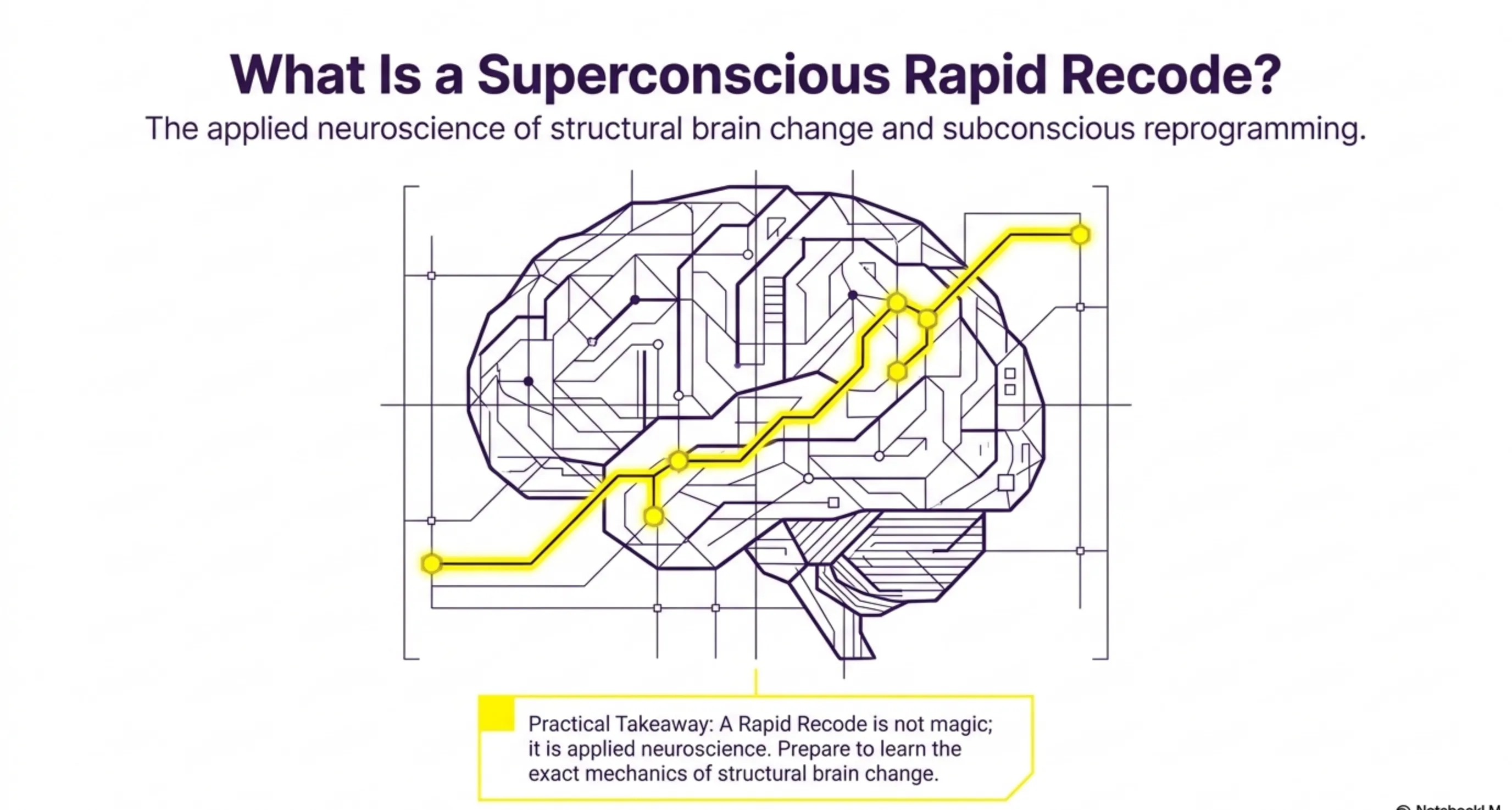
What Is a Superconscious Recode Session?
A Superconscious Recode session is a 60-minute consciousness coaching technique that uses a structured five-step process to identify a sabotaging subconscious belief, access the superconscious state, and recode the pattern at the level where it formed. The technique. Which this guide covers in depth. Is the core process of the Magnetic Mind Method developed by Christopher Duncan in 2019.
The "superconscious" in the name refers to a specific level of awareness above the everyday conscious and subconscious mind. Practitioners describe it as the state where creative insight, intuition, and natural problem-solving live. The part of you that knows what to do without effort or strategy. The Recode process is the means of getting there reliably and using that state to release the inner blocks that keep the same patterns repeating in everyday life.
What makes the Superconscious Recode distinctive is its specificity and speed. Where many personal-development modalities work through accumulated insight over months or years, the Recode is designed to address one specific sabotaging pattern in one focused session. Clients regularly describe a felt internal shift during the session itself, with behavioural and emotional changes integrating over the following one to three days.
Magnetic Mind certified practitioners deliver Superconscious Recode sessions worldwide, both in person and via Zoom. Sessions follow the standard structure. The first half surfaces the sabotaging behaviour or belief, the second half runs the Rapid Recode to clear it. Typical 1-on-1 session pricing ranges from $100 to $200 USD depending on the practitioner, with introductory rates often available for first-time clients.
How Does the Rapid Recode Process Work Step by Step?
The Rapid Recode follows the five-step protocol Christopher Duncan defined as the operational core of the Magnetic Mind Method. The practitioner guides you through each stage in real time. Knowing the steps in advance does not reduce the effect, because the work happens through your own engagement with each stage rather than through surprise.
Step 1: Choose the end result. The session opens with you naming the specific outcome you want to create. Not the problem you want to fix. This wording matters. Duncan's framework explicitly rejects the "remedial model" that focuses on what is wrong; it asks you to define what you actually want as your starting point. A client who arrives saying "I want to stop procrastinating on my launch" will be guided to restate this as "I want to launch the work and feel grounded while I do it."
Step 2: Establish structural tension. The practitioner helps you locate the gap between your current reality and your stated end result. This gap is not a problem to solve. It is the creative tension that drives change. As part of this step the practitioner guides you to recognise the sabotaging belief sitting in the gap, often one of the six core beliefs Duncan identifies: I'm not good enough, I'm not worthy, I'm not significant, I don't belong, I'm not capable, or I'm not perfect. This belief typically traces back to early childhood imprinting.
Step 3: Connect to the superconscious field. Through a specific guided focus, you shift out of the analytical conscious mind into the superconscious level of awareness. This is not a trance state. You stay fully alert, eyes open if you choose, verbally responsive throughout. The shift is recognisable as a quieting of internal commentary and a sense of clear, almost neutral observation. Duncan describes this layer as the source of intuition and creative insight that operates beyond rational sequencing.
Step 4: The Recode command. From the superconscious state, the practitioner runs the Recode protocol. A structured sequence of directed prompts that locate the resistance markers around the original belief and neutralise them at the level where they were imprinted. Most clients describe this as a recognisable internal moment: a sense of weight lifting, a release of tension that has been carried for years, occasionally a quiet emotional release. This is the recoding itself.
Step 5: Inspired action. The session closes with the practitioner integrating the shift and orienting you toward what Duncan calls inspired action. The deliberate, non-forced steps that follow naturally from the new internal state. The integration continues over the following 24 to 72 hours as your nervous system adjusts and the new pattern stabilises into automatic behaviour.
The underlying philosophy is captured in the title of Duncan's book: You're Not Broken. The Recode does not "fix" anything because nothing is broken. It clears the historical interpretation that was running underneath the surface, freeing you to operate from your actual capacity rather than from a childhood-formed protective pattern.
Where Does Superconscious Recode Come From?
The Superconscious Recode was developed by Christopher Michael Duncan, founder of Magnetic Mind and the Conscious Education Company. Duncan is a New York Times bestselling author whose 2021 book You're Not Broken: 5 Steps to Become Superconscious and Activate Your Magic sets out the framework that the Recode process operationalises.
The 2019 origin. Duncan introduced the Superconscious Recode in 2019 after more than a decade of his own work in subconscious-level personal development. He had previously built and exited multiple eight-figure companies. Most notably The Digital Marketing School, which he sold in early 2023. And observed that the limiting factor for most high-functioning people was not strategy or skill but the subconscious patterns that interfered with execution. The Recode was his answer to that observation: a repeatable, time-bounded process that addressed the pattern itself rather than working around it.
The Magnetic Mind Method. The Superconscious Recode is the core process of a broader framework Duncan calls the Magnetic Mind Method. The full method covers the six sabotaging beliefs that form in childhood, the structure of the superconscious state, the five-step Recode protocol, and a set of integration practices for daily life. Magnetic Mind operates as a global training organisation that certifies practitioners in the method. There are now tens of thousands of people using the Recode through certified coaches worldwide.
The certification lineage. Practitioners learn the Recode through Magnetic Mind's certification programmes, which combine intensive live training with supervised practice. Some certified practitioners. Also hold certification in 2-Point Healing, a complementary energy modality with its own lineage. The combination of Superconscious Recode (mind-level) and 2-Point Healing (body-level) is rare among consciousness coaches and offers a dual approach for clients whose patterns show up both in their thoughts and in their bodies.
How it differs from earlier consciousness work. The Recode draws on themes that appear across decades of mind-body and consciousness research. The subconscious imprinting work of Bruce Lipton, the neuroplasticity research operationalised by Joe Dispenza, the cognitive reframing core of cognitive behavioural therapy. What Duncan added was a specific time-bounded protocol that produces the felt shift in a single session rather than over a course of training. The five-step structure is the procedural innovation.
What Is the Science Behind Subconscious Reprogramming?
The science underneath Superconscious Recode rests on three well-established neuroscience principles. neuroplasticity, Hebbian learning, and theta-state imprinting. Combined with cognitive reframing from cognitive behavioural therapy and the broader research on subconscious processing.
Neuroplasticity. The brain forms and reshapes neural pathways throughout life in response to repeated thought and experience. This is the foundational finding of more than two decades of neuroscience research and is no longer scientifically contested. The practical implication for the Recode is direct: the neural pathway carrying a sabotaging belief was formed through repeated childhood reinforcement and can be replaced through a sufficiently focused experience that meets the original imprint at the same emotional depth.
Hebb's Rule. Neurons that fire together, wire together. Canadian psychologist Donald Hebb identified in the 1940s that repeated co-activation of two neurons strengthens the connection between them. This is why a belief held repeatedly for thirty years feels so solid. The underlying neural circuit has been reinforced thousands of times and now fires as default autopilot. The complementary process, synaptic pruning ("use it or lose it"), is how the brain weakens unused circuits. Together these two mechanisms explain both why old patterns are so durable and how new ones can replace them.
Theta-state imprinting. The brain's theta brainwave state (4–8 Hz) is the suggestible state where new beliefs are imprinted with low conscious resistance. Theta is dominant in children aged 0–7. Duncan and others refer to this as the "programming years" because almost everything a young child experiences imprints directly into the subconscious without critical filtering. Adults access theta naturally just before sleep and on waking, which is why those moments are commonly used in meditation and visualisation practices. The Superconscious Recode protocol is designed to reproduce a similar receptive state during a session.
Cognitive reframing. Cognitive behavioural therapy (CBT). One of the most extensively researched psychotherapy modalities. Works on the principle that changing the underlying interpretation of an event changes the resulting emotional and behavioural response. CBT has substantial published evidence for reducing anxiety, depression, phobias, and stress-related conditions. The Recode incorporates a cognitive reframing component but applies it at the subconscious rather than conscious level, which is why clients often report that the new pattern feels real rather than aspirational.
The 95% subconscious estimate. A figure that recurs across cognitive neuroscience literature. Popularised by cell biologist Bruce Lipton. Is that approximately 95% of daily thoughts, feelings, and behaviour are driven by the subconscious mind. Whether the precise number is 90% or 95% depends on how you define each category, but the practical point is consistent: the conscious analytical mind is responsible for a small fraction of what you actually do. This is why conscious-level interventions like positive affirmations or willpower-driven habit change so often fail to hold. They are operating on the wrong layer.
How long does new pattern integration take? Habit and neural pathway research suggests an average of around 66 days for a new automatic behaviour to fully form. Far longer than the popular "21 days" myth. The Recode produces the felt internal shift in a single session; the full neural integration of the new pattern as automatic behaviour stabilises across the following two to three months. This is why integration practices after the session matter. The recoding is the start of the new pathway, not its completion.
Where the research is still developing. The specific Superconscious Recode protocol has not been studied in published randomised controlled trials. The general principles it draws on are well evidenced; the specific combination Duncan developed has not been formally evaluated by independent researchers. Practitioners are appropriately careful to describe outcomes as client-reported rather than clinically proven. A free 90-minute workshop run by certified practitioners offer a way to experience the underlying principles before committing to a private session.
How Is Superconscious Recode Different from Other Approaches?
The Superconscious Recode shares ground with several adjacent modalities. Talk therapy, hypnotherapy, cognitive behavioural therapy, and law-of-attraction work. But differs in where it intervenes, how long it takes, and who is doing the work. The table below compares the most common approaches side by side.
| Feature | Superconscious Recode | Talk Therapy | CBT | Hypnotherapy | Law of Attraction / Affirmations |
|---|---|---|---|---|---|
| Layer addressed | Subconscious belief at original imprint | Conscious narrative + emotional processing | Conscious thought patterns | Subconscious via induced trance | Conscious intention only |
| Typical time to felt shift | One 60-minute session | Months to years | 8–20 sessions | 3–12 sessions | Inconsistent. Often no shift |
| Client state during work | Normal waking awareness, guided focus | Normal waking awareness | Normal waking awareness | Induced hypnotic trance | Normal waking awareness |
| Practitioner role | Guides protocol; client does the recoding | Listens, reflects, interprets | Teaches reframing skills | Delivers suggestions during trance | None (self-directed) |
| Evidence base | Neuroplasticity + reframing principles; protocol not in RCTs | Substantial across many modalities | Extensively researched, strong evidence | Moderate evidence base | Limited published evidence |
| Remote delivery | Yes. Via Zoom | Yes. Telehealth common | Yes. Telehealth common | Yes. Though less common | N/A. Self-directed |
The single most important difference is where the intervention happens. Talk therapy and CBT both operate primarily at the conscious level, working with the client's narrative and reasoning. Hypnotherapy reaches the subconscious but does so by inducing a trance state and delivering practitioner-led suggestions. Law-of-attraction work stays entirely at the conscious-intention level and does not address the subconscious blocks that prevent intention from translating into action.
The Superconscious Recode reaches the subconscious without inducing trance and keeps the client as the active agent throughout the process. The practitioner runs the protocol; the client does the recoding. This is why most people describe the felt shift as their own work, not as something done to them. For people who want to explore the foundational principles before booking a session, low-cost self-paced foundational programmes offered by Magnetic Mind certified practitioners draw on the same framework.
What Happens in a 60-Minute Session?
A standard Superconscious Recode session runs 60 minutes and follows a predictable two-half structure. Knowing the rhythm in advance reduces first-session uncertainty and helps you arrive ready to engage rather than ready to be assessed.
Before the session. You do not need to prepare anything specific. Many clients arrive with a particular pattern in mind. A recurring procrastination, an interaction that keeps going wrong, a self-critical loop that will not quiet. Other clients arrive with a vaguer sense of being stuck without naming the cause. Both are valid starting points. If anything, less rehearsal of what you "should" say tends to lead to more honest work in the session itself.
The first 30 minutes. Surfacing the pattern. The opening half of the session is structured discovery. The practitioner asks targeted questions to help you find the specific subconscious belief sitting beneath the surface symptom. This is rarely the answer you would have given before the conversation began. A client who arrives saying "I want to launch my business but I keep delaying" will often discover that the underlying belief is "I'm not significant" or "I don't belong". Patterns formed in childhood that are now showing up as adult procrastination. The practitioner does not interpret for you; they ask the questions that let you arrive at your own clarity.
The second 30 minutes. The Rapid Recode. Once the specific pattern is named and the original imprint located, the practitioner runs the five-step Recode protocol. You stay verbally engaged and fully alert throughout. There is no trance, no closed eyes for extended periods, no being "put under." The shift you feel is the result of focused work you are doing, not something the practitioner does to you. Many clients describe a recognisable internal moment when the pattern releases. A sense of weight lifting, a quieting of the internal commentary that has been running for years, occasionally a quiet emotional release.
After the session. The practitioner walks you through what happened, names what shifted, and gives integration guidance for the following 24 to 72 hours. Most people feel light, slightly tired, and clear. Drinking water, going for a walk, and avoiding heavy decision-making for a few hours afterward is generally recommended. The fuller integration. Where you start noticing that you simply do not have the old reaction to a previously triggering situation. Typically lands within three days.
In-person versus Zoom. The full Recode process works equally over Zoom and in person. The structured focus and the practitioner's guidance do not require physical proximity to take effect. For clients who specifically want body-level work alongside the mind-level Recode, the 2-Point Healing technique requires either physical presence or a different remote protocol. Those are typically booked as separate sessions or as a combined extended session.
Who Is Superconscious Recode Right For?
Superconscious Recode is best suited to people who can identify the specific pattern they want to shift and who want a faster pathway than long-form talk therapy. It is not better than conventional therapy. It is different, and the difference matters for some situations more than others.
You are likely to find a Recode session valuable if:
- You can name a specific recurring pattern. Procrastination, self-sabotage in relationships, fear of visibility, chronic indecision, a self-critical inner voice that has been running for years
- You have done conscious-level work (journalling, affirmations, self-help reading, conventional therapy) and intellectually understand the pattern but it keeps repeating anyway
- You want to address the cause, not the symptom, and you want to do it in one focused session rather than over months
- You are open to working at the subconscious level even though you cannot fully see in advance how the work will land
- You are an entrepreneur, creative, or high-functioning professional whose limiting factor is internal rather than external. Christopher Duncan originally designed the Recode for exactly this profile
You are likely to find Superconscious Recode less appropriate if:
- You are in active mental health crisis, including active suicidality, recent psychotic episode, or untreated severe trauma. These situations need qualified clinical support first; the Recode can complement that work later but should not replace it
- You are looking for someone to listen and reflect for an hour. That is the work of talk therapy and is valuable on its own terms; the Recode is structured intervention rather than reflective conversation
- You want a passive experience where the practitioner does the work to you. The Recode requires your active engagement throughout, which is a feature not a limitation
Common patterns the Recode addresses:
- Procrastination on the things you most want to do. Launches, creative work, big asks
- Self-sabotage at the threshold of success or visibility
- Persistent self-criticism, perfectionism, or never-good-enough loops
- Money blocks. Both earning ceiling patterns and spending sabotage
- Relationship patterns that repeat across different partners
- Chronic anxiety with a recognisable internal narrative behind it
- Fear of public speaking, being seen, or being known
- The six sabotaging beliefs in any of their adult expressions
The single common thread among people who get the most from Superconscious Recode is readiness to actually let the pattern go. Many people are intellectually ready to release a pattern long before they are emotionally ready to live without it. The Recode works fastest when those two are aligned. If you are uncertain whether you are ready, the free 90-minute workshop is a useful first step. It lets you feel the underlying principles without the commitment of a private session.
What Is the Bottom Line?
A Superconscious Recode session is a 60-minute, structured five-step process that addresses sabotaging subconscious beliefs at the level where they actually live. Not where they show up. Developed by Christopher Duncan in 2019 and now delivered by certified Magnetic Mind practitioners worldwide, the Recode draws on the well-established neuroscience of neuroplasticity and cognitive reframing to produce a felt internal shift in a single session rather than over months of incremental work.
The technique is well suited to people who can identify a specific pattern they want to shift and who want to address the cause rather than manage the symptom. It is not a replacement for clinical mental health care, particularly in active crisis. It is not the law of attraction with extra steps. The focus is on clearing internal blocks, not on willing outcomes into existence. And it is not passive: the practitioner runs the protocol; the client does the recoding.
If you have done the conscious-level work. The journals, the affirmations, the books, the talking. And you can name a pattern that keeps repeating despite all of it, the Recode is the layer underneath that the conscious-level tools cannot reach. The first session typically resolves whether the approach is right for you and whether the specific pattern you are targeting moves in response.
For anyone reachable by Zoom, a 1-on-1 Superconscious Recode session with a certified practitioner is typically priced comparably to a single counselling session, for a process designed to do the work in one. Free introductory workshops offered by certified practitioners are the lower-commitment entry point if you want to feel the framework before booking.
Important: Superconscious Recode is a complementary consciousness coaching modality. It is not a replacement for medical or mental health care, and people with diagnosed mental health conditions should engage it alongside. Not instead of. Qualified clinical care.
Frequently Asked Questions
Is Superconscious Recode the same as the law of attraction?
No. The law of attraction focuses on conscious intention and visualisation to attract outcomes. Superconscious Recode targets the subconscious beliefs that block intention from translating into action. The layer underneath visualisation. Christopher Duncan has been explicit that the Recode is about clearing internal blocks first; what people call "manifesting" follows from a clear nervous system, not from positive thinking alone.
How many sessions do most people need?
Many people experience a single dramatic shift from one session. Particularly when targeting a single specific belief or pattern. Clients working through layered patterns (chronic anxiety, long-term self-worth wounds, generational trauma) typically book three to six sessions across several weeks. Your practitioner will recommend a cadence after the first session.
Is Superconscious Recode safe?
The process is non-invasive and uses no medication, supplements, or physical intervention. It is generally considered safe for most adults. People with diagnosed mental health conditions. Particularly active PTSD, dissociative disorders, or psychosis. Should engage Superconscious Recode as a complement to (not a replacement for) qualified clinical care, and should disclose their diagnosis to their practitioner before booking.
Do I need to believe in it for it to work?
No. The process works on the subconscious level regardless of conscious belief about the technique itself. What matters is your willingness to engage with the prompts the practitioner offers and to be honest about the pattern you want to address. Sceptical engagement is welcome. Many of the strongest results come from people who arrived doubtful.
Is there scientific evidence for subconscious reprogramming?
There is direct evidence for two of the underlying mechanisms. First, neuroplasticity. The brain's capacity to form new neural pathways through repeated experience. Is well established across more than two decades of neuroscience research. Second, cognitive reframing (a key component of cognitive behavioural therapy) has a substantial evidence base for reducing anxiety and depression. The specific Superconscious Recode protocol has not been studied in randomised controlled trials, so practitioners describe outcomes as client-reported rather than clinically proven.
How is Superconscious Recode different from hypnotherapy?
Hypnotherapy uses induced trance states to access the subconscious. Superconscious Recode keeps the client in normal waking consciousness and uses guided focus to access the same layer. Sessions feel more like a structured conversation than a hypnotic induction. Both approaches address subconscious patterns; the Recode emphasises client agency throughout the process rather than practitioner-led suggestion.
Continue Reading
More from the blog
What Is 2-Point Healing and How Does It Work?
2-Point Healing is an energy technique using light touch at two specific body points to release blockages causing pain and distress. This guide covers origins, mechanism, research, and what to expect.
core-modalitiesConsciousness Coaching vs Life Coaching: Which Is Right for You?
Comparison of standard life coaching (GROW model, future-focused, ICF-defined) and consciousness coaching (subconscious pattern work, Magnetic Mind Method). When each fits, how they relate to therapy, and how to choose.
Keep exploring
Browse the rest of NeuralFlow's long-form guides on consciousness coaching, energy healing, and mind-body science. Every article is research-backed and built as a multi-format knowledge hub.
Read more articles