Depression After Loss: When Grief Gets Stuck in the Body

Depression after loss can be standard grief that resolves with time, prolonged grief disorder, a depressive episode triggered by loss, or grief that has gotten stuck in the body and needs body-based intervention. Standard grief support, EMDR for trauma-component loss, somatic experiencing for body-stuck grief, and clinical treatment for depressive episode each fit different presentations.
Key Questions Answered
How is grief different from depression?
Grief is loss-specific and waxes and wanes. Depression is more pervasive and constant. Grief includes positive memories of the loved one alongside the pain. Depression rarely does.
When does grief become "stuck"?
When acute intensity persists beyond 12 months and impairs functioning. When the body holds chronic activation that meaning-making work alone has not resolved.
What does "stuck in the body" mean?
The autonomic nervous system has not received the signal that the threat is over. Chronic sympathetic activation persists as physical residue: tension, insomnia, fatigue, immune disruption, GI symptoms.
Which approaches help body-stuck grief?
Somatic experiencing addresses the autonomic activation directly. EMDR helps when traumatic memory components are present. Combined with standard grief therapy for the meaning layer.
When do I need clinical treatment?
When suicide risk is present. When daily function has substantially declined. When grief has become depression with vegetative symptoms.
In This Guide
Key Takeaways
- Standard grief intensity reduces over 6 to 12 months for most people; persistent high-intensity grief beyond 12 months meets criteria for prolonged grief disorder.
- Depression after loss can be grief, prolonged grief disorder, depressive episode, or body-stuck grief; treatment differs across these.
- Body-stuck grief presents as physical residue that meaning-making work has not resolved.
- Somatic experiencing, EMDR for trauma-component loss, and trauma-informed yoga are evidence-supported approaches.
- Combined treatment (talk therapy + body-based work + clinical treatment when needed) consistently outperforms single-modality care.
Listen to the deep-dive on this article
A two-host audio overview of the key ideas. Origins, mechanism, evidence, and what to expect. Useful when you would rather listen than read.
Why the Distinctions Matter
"Depression after loss" is not one thing. The presentation can be standard grief, prolonged grief disorder, a depressive episode triggered by loss, or body-stuck grief. The treatment differs across these.
Standard grief: intense feeling, often with depressive features, that follows the natural arc of integration over 6 to 12 months. Treatment: time, social support, ritual, possibly grief therapy.
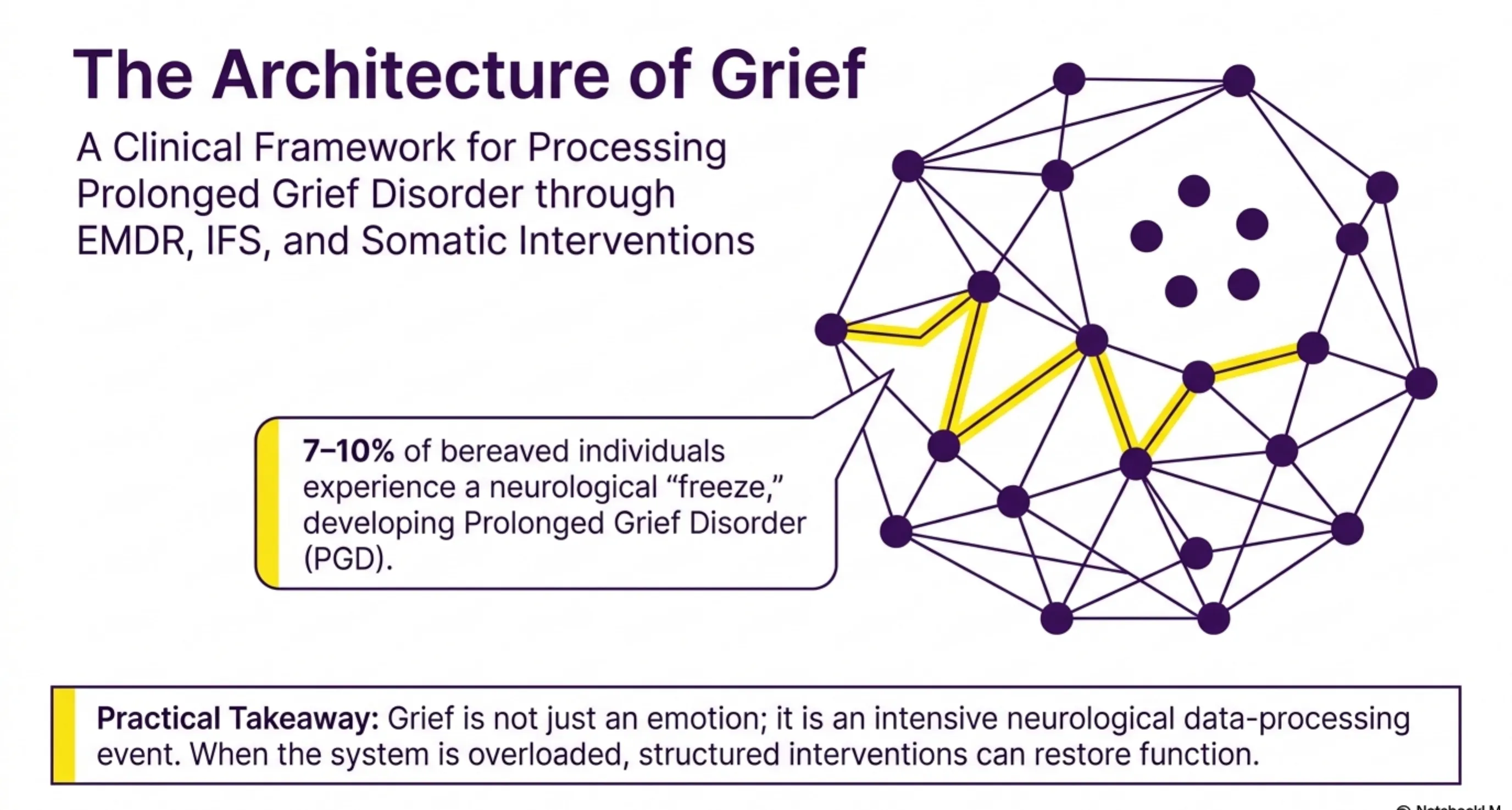
Prolonged grief disorder: high-intensity grief persisting beyond 12 months with functional impairment. Recognised in DSM-5-TR and ICD-11. Treatment: structured complicated-grief therapy, often with body-based components.
Depressive episode triggered by loss: meets clinical criteria for major depressive disorder, with vegetative symptoms. Treatment: clinical care, often medication and psychotherapy combined.
Body-stuck grief: meaning-making work has been done but the body holds chronic activation. Treatment: body-based approaches alongside continued grief support.
Most complicated grief presentations include elements of multiple categories. The right starting point is accurate assessment.
Why Grief Gets Stuck in the Body
Loss activates the same threat-response systems as physical danger. Sympathetic nervous system activation. HPA-axis activation.
Normally, this activation cycles through and resolves. Sometimes the resolution does not happen. The activation becomes chronic. The body stays mobilised in a low-grade alarm state.
The physical signs: constant tension, often in the chest, throat, or abdomen. Sleep disruption. Fatigue that does not respond to rest. A sense of being "in" the grief without being able to fully feel or process it.
This is the body holding what the mind cannot fully process. The conscious mind has often done excellent work. The autonomic system needs different intervention.
Somatic Experiencing for Body-Stuck Grief
Somatic experiencing addresses chronic autonomic activation by working with the body's natural capacity to complete what was interrupted. For grief, the protocol works with the autonomic responses that the loss interrupted or could not complete.
The mechanism: many losses involve responses the bereaved could not enact. The protective response that came too late. The fight or flight that had no target. These responses live in the autonomic system as unresolved activation.
Somatic experiencing helps complete these responses through small, titrated movements and attention practices. The aim is not to relive the loss but to allow the autonomic system to finish what was interrupted.
Sessions look different from talk therapy. Less narrative, more attention to body sensation. Five to fifteen sessions is a typical course.
The fit is strongest for grief that has a clear "frozen" quality. The bereaved feels stuck rather than sad, numb rather than mourning, tense rather than tearful.
EMDR When the Loss Was Traumatic
EMDR is particularly fitted for grief that includes traumatic memory components. Sudden death. Witnessed death. Death from violence or accident. Loss in circumstances the bereaved feels guilty about.
The EMDR grief protocol applies the bilateral-stimulation framework used for PTSD to grief-specific memories and triggers. The aim is processing of the traumatic memory components so they integrate into ordinary autobiographical memory.
Pilot studies show reductions in grief intensity scores, reductions in PTSD-like symptoms, and improvements in functional grief integration.
Who fits this protocol: people whose grief includes intrusive memories of the dying or the discovery of death. People with survivor guilt or rumination on what could have been done differently.
When Clinical Care Is the Right Starting Point
Several patterns indicate clinical evaluation should come first.
Suicide risk. Any active suicidal ideation. Immediate clinical care.
Severe vegetative symptoms beyond grief's pattern. Sleep disruption that produces only 2-3 hours per night. Significant weight change. Anhedonia beyond grief's natural pattern.
Substantial functional decline. Cannot work. Cannot maintain basic daily function.
Grief alongside other clinical presentations. Pre-existing depression that has worsened. Substance use that is escalating.
Trauma history that has become activated. Previous trauma reactivated by current loss can produce complex presentations that need trauma-specialist care.
For all of these, body-based work and grief therapy are valuable but typically as part of layered treatment that includes clinical care.
Frequently Asked Questions
How long is "normal" grief?
Acute grief intensity typically reduces over 6 to 12 months for most people. Persistent high-intensity grief beyond 12 months meets criteria for prolonged grief disorder.
Should I avoid medication for grief?
Not necessarily. Standard grief generally does not require medication. Depressive episode triggered by loss may benefit from medication alongside therapy.
What if I keep crying for years?
Persistent grief is not necessarily complicated grief if functioning is intact. Some losses are large enough that intense feeling continues; that is human, not pathological.
Is it possible to "get over" loss?
No, and that is not the goal. The goal is integration, not erasure. The loss becomes part of the self rather than the entire self.
Continue Reading
More from the blog
Keep exploring
Browse the rest of NeuralFlow's long-form guides on consciousness coaching, energy healing, and mind-body science. Every article is research-backed and built as a multi-format knowledge hub.
Read more articles