Energy Healing for Anxiety: What the Research Actually Shows

EFT (Emotional Freedom Technique) has 56 randomised controlled trials with moderate-to-large effect sizes for anxiety, including a representative study showing 24% cortisol reduction versus 14% in supportive interview controls. A 2024 Reiki meta-analysis covering 13 studies and 824 patients found significant effect on anxiety. The honest framing: energy healing has substantial evidence at moderate effect size, weaker than first-line CBT or SSRIs, with a much better safety profile than either.
Key Questions Answered
Does energy healing actually reduce anxiety?
Yes, with moderate effect sizes that are smaller than first-line CBT but reliably above placebo for several modalities. EFT has the strongest evidence base. Reiki shows significant effect on anxiety across 13 studies covering 824 patients in a 2024 meta-analysis.
How does it compare to CBT or medication for anxiety?
Smaller effect sizes than evidence-based first-line treatment. EFT effect sizes for anxiety run roughly d = 1.23 in meta-analyses, large in absolute terms but smaller than CBT in head-to-head trials. The advantage is the safety profile and accessibility.
What is the actual mechanism?
Autonomic nervous system regulation. Tapping, focused contact, and guided attention shift the body from sympathetic activation toward parasympathetic dominance. Cortisol drops, heart rate variability improves, breathing deepens.
When should I try energy healing for anxiety?
When you want a low-risk complement to existing treatment. When CBT or medication has produced partial improvement. When anxiety has a clear stress-load component. When you prefer to start with the most accessible self-applied option (EFT) before committing to therapy.
When is energy healing the wrong choice?
When anxiety is severe enough to impair daily functioning. When there is active panic disorder or agoraphobia. When the underlying driver is a clinical depression that needs concurrent treatment.
In This Guide
- What's Actually in the Evidence
- How It Works in the Body
- EFT: The Most Accessible Self-Applied Tool
- Reiki and the Clinical Evidence Base
- How It Compares to CBT and Medication
- When to Try Energy Healing for Anxiety, and When Not To
- What a Good Energy Healing Session for Anxiety Looks Like
- Integrating Energy Healing With Existing Anxiety Treatment
Key Takeaways
- A 2022 Frontiers in Psychology systematic review by Stapleton and colleagues identified 56 randomised controlled trials of Clinical EFT, with moderate-to-large effect sizes for anxiety, depression, PTSD, and stress.
- A representative EFT trial showed 24% cortisol reduction in the EFT group versus 14% in supportive interview controls and 14% in no-treatment controls. Cortisol reduction is a direct biomarker of autonomic regulation.
- A 2024 Reiki meta-analysis published in BMC Palliative Care covering 13 studies and 824 patients found significant impact on anxiety, particularly for short-term interventions of 3 sessions or fewer.
- Reiki shows the strongest evidence for procedural anxiety (gastrointestinal endoscopy, surgery) and chronic-condition anxiety (fibromyalgia, depression).
- Effect sizes are real and reliable but smaller than CBT or SSRIs for severe anxiety. Safety profile is excellent. Best use case is complementary care, mild-to-moderate anxiety, or anxiety that has hit a ceiling with conventional treatment.
Listen to the deep-dive on this article
A two-host audio overview of the key ideas. Origins, mechanism, evidence, and what to expect. Useful when you would rather listen than read.
What's Actually in the Evidence
The evidence for energy healing as treatment for anxiety is stronger than most general practitioners assume, and weaker than most healing-modality marketing claims. Both extremes miss the actual picture.
EFT has the largest evidence base. A 2022 Frontiers in Psychology systematic review by Peta Stapleton and colleagues identified 56 randomised controlled trials covering Clinical EFT for anxiety, depression, PTSD, stress, and physical symptoms. Effect sizes for anxiety run in the moderate-to-large range. A representative study showed 24% cortisol reduction in the EFT group versus 14% in supportive interviews.
Reiki sits in second place. A 2024 meta-analysis published in BMC Palliative Care covered 13 studies and 824 patients. Reiki produced significant impact on anxiety, particularly for short-term interventions of 3 sessions or fewer.
Therapeutic Touch has moderate evidence for short-term anxiety reduction in hospital settings, established in the 2004 Bronfort systematic review.
This is real evidence. The effect sizes are smaller than first-line CBT for anxiety. They are larger than placebo in the strongest studies. The safety profile is excellent.
How It Works in the Body
The energetic-field claims have weak evidence. The autonomic nervous system claims are well supported.
The autonomic nervous system has a sympathetic branch and a parasympathetic branch. Healthy regulation means smooth shifts between them. Chronic anxiety is, neurobiologically, sustained sympathetic activation that the system cannot exit.
Each major energy healing modality produces measurable parasympathetic activation. Cortisol drops. Heart rate variability improves. Breathing deepens. Vagal tone strengthens.
The mechanism is not unique to energy healing. What is somewhat unique is the efficiency. EFT tapping reaches measurable autonomic shifts in 10 to 20 minutes. Reiki sessions produce them in 20 to 45 minutes.
For anxiety specifically, this efficiency matters. People with active anxiety often cannot meditate. The meditation requires the regulated state the anxiety is preventing. Energy healing modalities provide an external scaffold that produces the regulated state without requiring the client to already have it.
EFT: The Most Accessible Self-Applied Tool
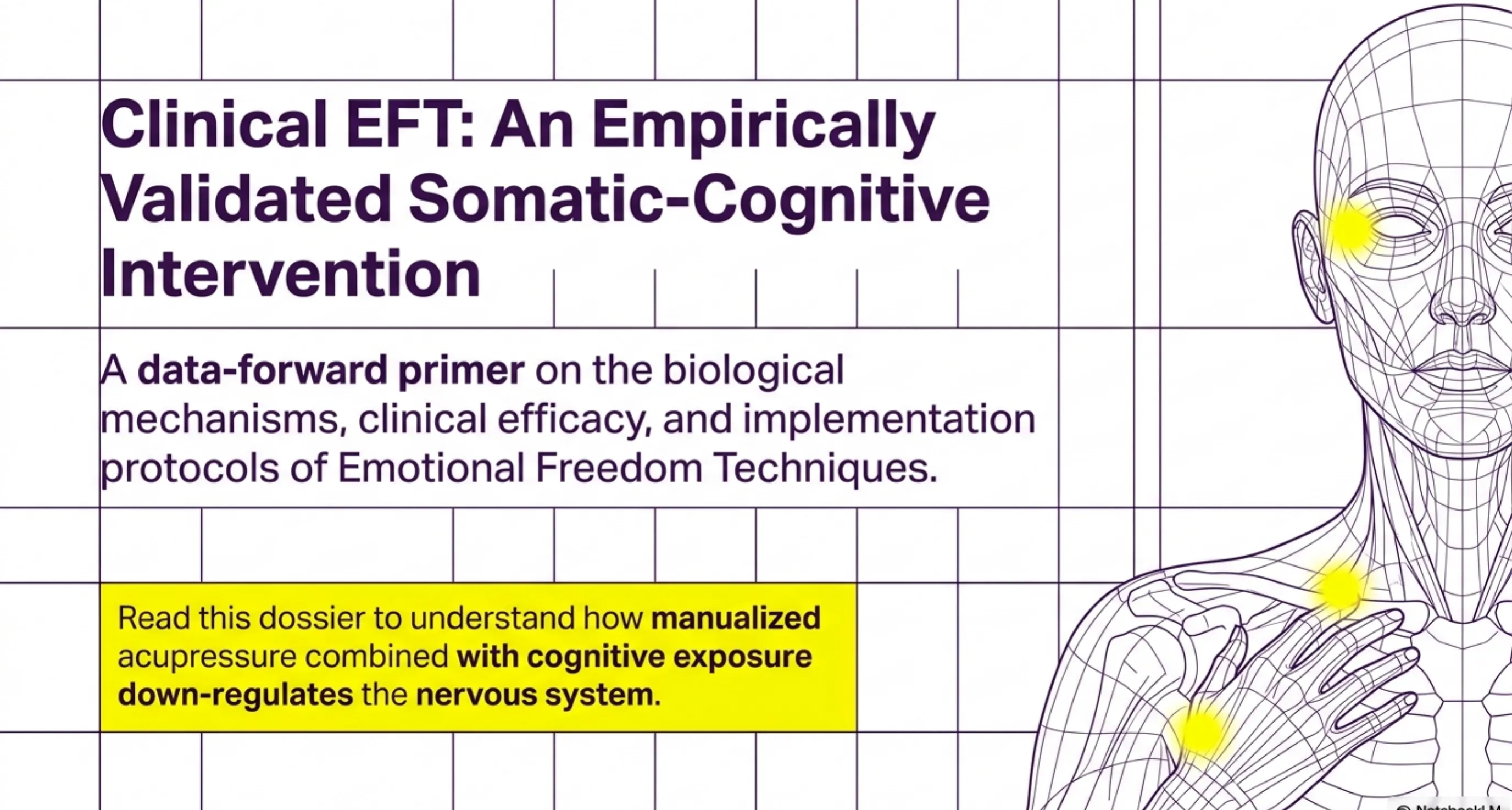
Emotional Freedom Technique. Developed by Gary Craig in the 1990s. Combines fingertip tapping on acupressure meridian points with verbal phrases that name the anxiety being worked on.
The basic protocol takes 20 minutes to learn from a free YouTube tutorial. The tapping points: side of hand, eyebrow, side of eye, under eye, under nose, chin, collarbone, under arm, top of head. Two rounds through the points while speaking specific setup statements and reminder phrases produce measurable autonomic shifts in most users.
The 56 randomised controlled trials covered different anxiety presentations. Effect sizes in meta-analyses ran roughly d = 1.23 for anxiety.
The methodological caveats. Many studies are small. Blinding is harder than for medication trials. The effect sizes that survive across the variation are real, but the strongest studies use methodologies that mainstream psychology research has not fully accepted.
For self-applied work: try it for two weeks of daily 15-minute sessions. Track anxiety on a 0 to 10 scale before and after each session. If the average level drops by 2 or more points across two weeks, the modality is working for you.
Reiki and the Clinical Evidence Base
Reiki was developed by Mikao Usui in 1920s Japan. The practitioner places hands lightly on or just above the client's body in specific positions for 60 to 90 minutes.
The 2024 BMC Palliative Care meta-analysis covered 13 studies, 824 patients. Reiki produces significant reduction in anxiety scores, with the effect strongest for short-term interventions (1 to 3 sessions) and moderate-frequency series (6 to 8 sessions across 4 to 8 weeks).
Specific clinical contexts where Reiki showed the strongest effects. Pre-procedural anxiety for gastrointestinal endoscopy. Post-cesarean section anxiety. Fibromyalgia patients. Older adults with chronic conditions. Patients receiving chemotherapy.
Where the effects are weaker. Death-related anxiety in advanced cancer patients. Preoperative anxiety for major surgery. Pure social anxiety. Reiki is most useful when the anxiety has a strong somatic-arousal component.
Mechanism. The autonomic regulation hypothesis holds. Reiki sessions produce measurable cortisol reduction, lower respiration rate, decreased systolic blood pressure. The 2017 Baldwin pilot study showed Reiki recipients' respiration rate dropped from 20.1 to 17.7 breaths per minute at 48 hours post-surgery.
How It Compares to CBT and Medication
Energy healing for anxiety performs at smaller effect sizes than first-line evidence-based treatment.
CBT for anxiety has effect sizes around d = 1.5 to 2.0 in well-designed trials. SSRIs and SNRIs have effect sizes around d = 0.5 to 1.0. EFT for anxiety has effect sizes around d = 1.23. Reiki shows significant effect with effect sizes typically in the d = 0.5 to 1.0 range.
What this means. CBT, when delivered by a trained therapist over 12 to 20 sessions, produces the largest reliable reduction in anxiety symptoms. Medication produces a moderate reduction with much faster onset. Energy healing produces a moderate reduction with the smallest barrier to entry.
For mild-to-moderate anxiety, energy healing is a reasonable first try.
For moderate-to-severe anxiety, energy healing belongs alongside CBT or medication, not instead of them. The combination consistently outperforms either alone for the substantial subgroup of patients who respond partially to first-line treatment.
For severe anxiety presentations (panic disorder with agoraphobia, severe generalised anxiety disorder), energy healing is not the right primary modality.
The honest framing is "different tools for different presentations, and most people benefit from layered care."
When to Try Energy Healing for Anxiety, and When Not To
Five situations where energy healing is a strong fit.
Mild-to-moderate anxiety not yet treated with CBT or medication. EFT is a reasonable first-line option.
Anxiety that has hit a ceiling with conventional treatment. Substantial improvement, but not full resolution. The remaining 30% of symptoms is often the autonomic-regulation layer.
Anxiety with a clear somatic-arousal component. Body activation, heart racing, breathing tightness, GI distress.
Procedural or situational anxiety. Pre-surgery, pre-procedure, dental anxiety. Reiki has particularly strong evidence here.
Anxiety with a clear stress-load component. The kind that ramps up under work pressure and ramps down on quiet weekends.
Five situations where energy healing is the wrong primary tool.
Severe presentations with functional impairment. Cannot leave the house. Cannot work. Needs first-line evidence-based treatment.
Active panic disorder, particularly with agoraphobia.
Anxiety as symptom of underlying medical issue. Thyroid dysfunction, cardiac issues, medication side effects.
Anxiety in active mental health crisis. Suicidal ideation, severe depression alongside anxiety.
Trauma-rooted anxiety in early treatment phase. The somatic activation can be intensified by some modalities before it resolves.
What a Good Energy Healing Session for Anxiety Looks Like
The structure of an effective anxiety session has predictable shape.
Before. Brief check-in. Name the specific anxiety that is loudest right now. Rate it on a 0 to 10 scale. Note where in the body it shows up.
During. EFT runs through the tapping points twice while speaking setup and reminder phrases. Reiki involves the practitioner placing hands in sequence at specific positions while you lie still.
Sensations to expect. Warmth at contact points. Sometimes mild tingling. Spontaneous deeper breaths. Occasional emotional release. Drowsiness in the second half. None of these are required.
After. Re-rate the anxiety. A drop of 2 to 4 points in a single session is typical for moderate anxiety. A drop of 1 to 2 points is normal for entrenched chronic anxiety. A drop of 5+ points sometimes happens.
The post-session window matters. The autonomic state is more flexible for 4 to 12 hours after a good session. Activities that consolidate the regulated state (gentle walk, time outdoors, quiet meal, sleep) extend the benefit.
Most people who respond well see continued improvement across 4 to 8 sessions. Tracking the daily anxiety average across weeks is more useful than tracking single-session changes.
Integrating Energy Healing With Existing Anxiety Treatment
The right pattern is integration rather than substitution.
If you are in CBT. Energy healing addresses the somatic and autonomic layers that CBT does not target directly. EFT works particularly well as homework between CBT sessions. Mention to your therapist; most are supportive.
If you are on medication. Energy healing does not interact pharmacologically with SSRIs, SNRIs, benzodiazepines. The autonomic regulation is additive. Most people on medication who add EFT or Reiki notice improvement within 4 to 8 weeks. Discuss with your prescribing clinician before considering tapering medication.
If you have tried treatment and it did not help. Energy healing is worth trying as a different mechanism. CBT works on cognitive patterns. Medication works on neurotransmitter systems. Energy healing works on autonomic regulation. Some anxiety presentations respond to one of these and not the others.
If you have severe anxiety that has not been clinically evaluated. Get the evaluation first. Anxiety is the symptom that overlaps most with other clinical conditions.
The pattern that consistently produces the best outcomes is layered care. Conventional treatment for the conditions it treats best. Body-first work for the autonomic layer. Self-applied tools for daily maintenance. Energy healing earns its place in this layered structure as a low-cost low-risk component.
Frequently Asked Questions
Is the EFT evidence base actually credible? It seems too large.
The 56-RCT figure surprises people. The evidence is real but the field has methodological limitations. Many studies are small (n under 100). Some have flaws in blinding. The effect sizes that survive across multiple studies and multiple research teams are credible at the moderate-to-large range.
Can I do EFT on myself or do I need a practitioner?
Self-applied EFT works for surface anxiety. Free tutorials cover the basic protocol in 20 minutes. For trauma-rooted anxiety, working with an EFT-certified practitioner for the first 4 to 6 sessions is recommended because the protocol can briefly intensify the original feeling before resolving it.
How does Reiki compare to EFT for anxiety?
EFT has the larger evidence base and the more accessible self-application. Reiki has stronger evidence in clinical settings where the practitioner is part of the intervention. Both produce measurable autonomic regulation.
What about PSYCH-K, Therapeutic Touch, and other less-known modalities?
Smaller evidence bases than EFT or Reiki. Therapeutic Touch has moderate evidence for short-term anxiety reduction in hospital settings. PSYCH-K is largely practitioner-reported. Healing Touch sits between these.
Should I stop my anxiety medication if energy healing is working?
No, not without your prescribing clinician's involvement. SSRIs, SNRIs, benzodiazepines have specific tapering protocols. Stopping abruptly can produce discontinuation syndromes that are themselves anxiety-amplifying.
Continue Reading
More from the blog
Keep exploring
Browse the rest of NeuralFlow's long-form guides on consciousness coaching, energy healing, and mind-body science. Every article is research-backed and built as a multi-format knowledge hub.
Read more articles