Negative Self-Talk Recode: The Neuroscience of Why Fixing the Inner Critic Backfires

Negative self-talk runs on the Default Mode Network, the same brain system that handles self-referential thought during rest. Hebbian learning hardwires repeated inner-critic loops into automatic habits, which is why fighting the voice strengthens the circuit. A Recode approach moves the practice through Thinking, Doing, and Being so the new pattern becomes subconscious. Flow states, mental rehearsal, and the Magnetic Mind Method "you are not broken" framing collapse the fixing loop and let the brain wire a different default voice.
Key Questions Answered
Why does my negative self-talk keep repeating the same lines?
Because the Default Mode Network (DMN) plays back self-referential content automatically during rest, and Hebbian learning ("nerve cells that fire together, wire together") hardwires repeated thoughts into habit circuits. The lines repeat because the wiring repeats them.
Why does fighting the inner critic make it louder?
Because fighting it keeps attention on the flaw, which fires the same DMN circuit again. The Magnetic Mind Method calls this the fixing loop. Christopher Duncan: "people aren't broken." The Recode approach replaces the fixing loop with a creative orientation.
What is the actual difference between an affirmation and a Recode?
An affirmation lives in the Thinking stage and stays at the neocortex. A Recode moves through Thinking, Doing, and Being so the new pattern is rehearsed in the body, hardwired through Hebbian learning, and finally runs as subconscious automaticity, the way Joe Dispenza describes in Evolve Your Brain.
How does a flow state turn the inner critic off?
Flow downregulates the DMN (the medial prefrontal cortex and posterior cingulate quiet down), upregulates the Executive Control Network, and produces what researchers call transient hypofrontality. Self-consciousness drops out. A 2024 longitudinal study (Gaston et al.) found high flow proneness was associated with a 16% reduction in depression risk and a 16% reduction in anxiety risk.
Can I do a Recode without a coach?
The foundational protocols are self-applied: mental rehearsal in the morning, challenge-skill balanced practice to drop into flow, and a deliberate shift from fixing language to creative-orientation language. Identity-level work usually benefits from a trained practitioner like Greg Jones who layers Superconscious Recode and 2-Point Healing in a structured engagement.
In This Guide
- Why Does the Inner Critic Repeat the Same Lines?
- What Is Actually Happening in the Brain When You Talk Down to Yourself?
- Why Does Fighting the Inner Critic Make It Stronger?
- How Does a Flow State Quiet the Inner Critic?
- What Is the Difference Between an Affirmation and a Recode?
- What Does a Negative Self-Talk Recode Protocol Actually Look Like?
- What Is the Bottom Line?
Key Takeaways
- The Default Mode Network is the brain system that runs self-referential thought during rest, and the same network produces the repeating lines of the inner critic. The DMN spans the anterior medial frontal cortex, posterior cingulate cortex, precuneus, and inferior parietal lobule.
- Hebbian Learning hardwires repeated thoughts into automatic habits, whether they are skills or emotional addictions to a critical voice. This is why the inner critic strengthens with practice, even unwanted practice.
- Flow states downregulate the DMN and upregulate the Executive Control Network, producing transient hypofrontality where self-consciousness vanishes. Gaston et al. 2024 link high flow proneness to reduced risk of depression (16%), anxiety (16%), schizophrenia (15%), and bipolar disorder (12%).
- Trying to fix the inner critic keeps attention on the flaw and fires the same circuit. Christopher Duncan's Magnetic Mind Method reframes the work: "you are not broken." The shift is from a fixing orientation to a creative orientation.
- A Recode runs the new pattern through three stages: Thinking (knowledge in the neocortex), Doing (mental and physical rehearsal that builds new circuits), and Being (the pattern hardwired into the cerebellum and subconscious so it runs automatically).
Listen to the deep-dive on this article
A two-host audio overview of the key ideas. Origins, mechanism, evidence, and what to expect. Useful when you would rather listen than read.
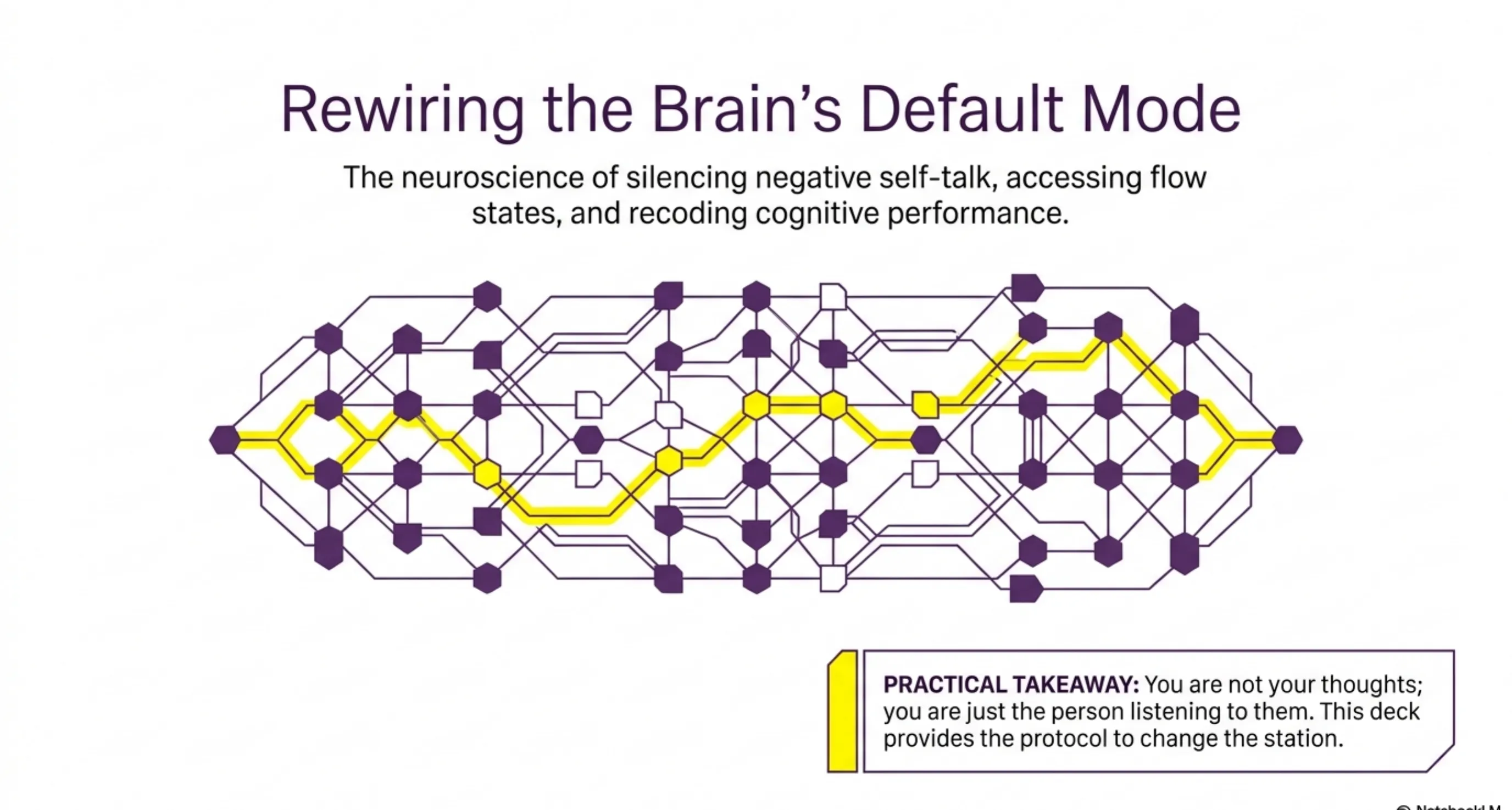
Why Does the Inner Critic Repeat the Same Lines?
The lines do not change much. They sound like other people from your past, or like a verdict the system reached years ago, and they show up uninvited at predictable moments.
The reason for the repetition is structural. The brain has a system that runs self-referential thought during rest. Modern neuroscience calls it the Default Mode Network, and it spans the anterior medial frontal cortex, the posterior cingulate cortex, the precuneus, and the inferior parietal lobule. The DMN is the system that hums in the background when you are not focused on a specific task. It pulls up autobiographical memory. It simulates the future. It runs the internal narrative.
Two hypotheses explain what it is doing. The Sentinel Hypothesis says the brain is monitoring the environment for threat even when you are not actively scanning. The Internal Mental Activity Hypothesis says the DMN is generating self-reflection, mental simulation, and memory retrieval. In practice both are happening, and when the threat-monitor tilts inward, the system starts treating you as the threat.
Repetition then does the rest of the work. Hebb's Law, often quoted in the consciousness-coaching literature as "nerve cells that fire together, wire together," explains how. Each time the inner-critic line repeats, it strengthens the circuit that produces it. After enough repetitions the circuit becomes a habit. Joe Dispenza describes this directly in Evolve Your Brain: repeated thoughts and emotions get hardwired the same way physical skills do, whether you wanted them or not.
That is the loop. DMN runs the narrative. Hebbian learning compounds it. The lines repeat because the wiring repeats them.
What Is Actually Happening in the Brain When You Talk Down to Yourself?
Three DMN subsystems carry most of the load.
| DMN Subsystem | What It Does | Role in Negative Self-Talk |
|---|---|---|
| Central Core (mPFC, PCC) | Self-reflective processing and sensory integration | Generates the "this is who I am" verdict that the inner voice repeats |
| Medial Temporal Subsystem | Memory retrieval and prospective scenario building | Pulls up the past-failure highlight reel and projects it forward |
| Medial Prefrontal Subsystem | Affective processing and emotional regulation | Adds the emotional charge that makes the lines feel true |
The DMN does not produce a single voice. It produces a layered self-referential field: identity verdict, memory retrieval, emotional weight. The inner critic is the voice you hear, but the brain machinery is the field underneath.
Childhood adversity tunes the field early. Chronic stress and neglect impair DMN maturation. Stress-induced cortisol can inhibit oligodendrocytes, reducing myelin production and slowing neural signal transmission. The connectivity patterns that result, hyperconnected or hypoconnected DMN, persist into adulthood and show up as depression, PTSD, or a chronic inner-critic loop.
This is why "just stop thinking that way" rarely works. The instruction is aimed at the conscious layer. The pattern is wired into the substrate.
Why Does Fighting the Inner Critic Make It Stronger?
Hebbian learning is the answer. Fighting the inner critic keeps attention on the flaw. Attention fires the circuit. The circuit strengthens.
Christopher Duncan, who built the Magnetic Mind Method after a near-death experience in 2009, frames the alternative directly. People need to realise they aren't broken, he writes; who they are right now is fine, and the work is choosing who to become from here. The shift sounds philosophical and is actually mechanistic. A fixing orientation reinforces the original wiring by giving it sustained attention. A creative orientation builds different wiring by giving attention to a different target.
The encounter that taught Duncan this is in the report. An anonymous billionaire told him: "Chris, you have to BE it to SEE it." Duncan was living toward his vision rather than in it, which kept his system in chronic gap-state, scanning for what was missing. Living in the vision shifts the DMN target. The internal narrative then plays from the new identity, not from the old one being repaired.
This is not positive thinking with extra steps. It is a structural choice about what the substrate replays. You can spend a decade in a fixing loop, polish every flaw, and still wake up to the same inner voice because the wiring has been kept alive by the focus on it.
How Does a Flow State Quiet the Inner Critic?
Flow does the opposite of what the fixing loop does. It downregulates the DMN.
The systematic review in the report puts it concisely: "Flow emerges as a unique neurocognitive phenomenon marked by selective DMN suppression and enhanced ECN engagement." Two networks are in conversation. The DMN, which carries self-referential thought, quiets down. The Executive Control Network, which handles attentional control, ramps up. The medial prefrontal cortex and posterior cingulate go offline. The inner narrator stops narrating.
In experts the effect goes further. Researchers call it transient hypofrontality, a temporary letting-go of executive oversight that allows implicit, automatic processes to take over. It is what jazz improvisation looks like inside the brain. It is also what athletes describe as "the zone." The self that the inner critic talks to is briefly gone.
The conditions for flow are specific. Challenge has to balance skill. A task slightly above current capacity opens the door. Too easy and the DMN re-activates as boredom. Too hard and the amygdala fires as anxiety. The sweet spot is narrow and trainable.
The longitudinal evidence is encouraging. Gaston et al. 2024 followed individuals with high flow proneness and documented health risk reductions across psychiatric and physical conditions:
| Condition | Risk Reduction in High-Flow Individuals |
|---|---|
| Depression | 16% |
| Anxiety | 16% |
| Schizophrenia | 15% |
| Bipolar Disorder | 12% |
| Cardiovascular Disorders | 4% |
The numbers here are genuinely encouraging. They suggest that systematic flow practice operates as what one researcher in the report calls "a naturally occurring regulatory mode" that quenches rumination at the network level.
What Is the Difference Between an Affirmation and a Recode?
An affirmation lives at the Thinking stage. A Recode runs the loop all the way through.
Joe Dispenza's framework in Evolve Your Brain describes three stages of neuroplastic change. They are not interchangeable.
| Stage | Action | Where the Pattern Lives |
|---|---|---|
| Thinking | Acquiring knowledge about the new pattern | Neocortex; intellectual recognition |
| Doing | Physical or mental practice that fires the new circuit repeatedly | New circuits forming in the relevant motor and cognitive regions |
| Being | The pattern runs without conscious effort | Hardwired in the cerebellum and subconscious; brain and body work as one |
Most affirmations fail because they stop at Thinking. Saying "I am confident" once a day for thirty seconds is intellectual recognition of a pattern, not the pattern itself. The neural circuit that the brain repeats for the rest of the day is the older, denser one.
A Recode forces the loop into the Doing stage. Mental rehearsal, run vividly enough that the brain registers it as experience, fires the new circuit hundreds of times instead of dozens. The actual goal is the Being stage, where the new pattern operates as automaticity. That is where the inner voice changes for real, because the substrate has changed.
Dispenza's line, in the report, is the one to remember: "knowledge must be experienced before it can become wisdom." Knowledge is Thinking. Wisdom is Being. The Doing stage is the bridge, and most people never cross it.
What Does a Negative Self-Talk Recode Protocol Actually Look Like?
The protocol has four moving parts. None of them are exotic. Together they cross the bridge from Thinking to Being.
Mental rehearsal in the morning. Spend ten to twenty minutes in a vivid first-person rehearsal of the day, the conversations, the decisions, the responses, run through the new internal voice. Sensory detail matters. The brain registers the rehearsal as experience and fires the target circuit. Run it before the inbox opens, while the prefrontal cortex is fresh.
The biological case for this is in the report and in Dispenza's longer body of work. The brain does not draw a clean line between vivid imagined experience and lived experience at the level of circuit activation. That is why visualisation operates as a rewiring tool rather than as wishful thinking.
Daily flow practice. Pick one skill-based or creative practice and dial the challenge to one notch above current capacity. Music, sport, writing, design, gardening, climbing, freediving, anything that demands undivided attention at a calibrated level. Twenty to forty minutes most days. The DMN downregulates. The inner critic loses the floor.
Salience-network training. Five to fifteen minutes of breath-anchored mindfulness builds the toggle between DMN and ECN. The skill the practice trains is not the absence of thought; it is the ability to notice that the DMN has hijacked the floor and to switch back.
Creative-orientation language. Audit the voice for fixing-loop framing. "I need to stop being so anxious" keeps the focus on the anxiety. "I am building the version of me who is steady under pressure" puts the DMN target on the new identity. The phrasing is not cosmetic. It changes what the substrate replays.
Practitioners who specialise in identity-level work combine these layers into a structured engagement. Greg Jones works with clients across 6 to 12 sessions, layering consciousness coaching with 2-Point Healing in an approach informed by the Magnetic Mind Method. Sessions are available in person in Motueka and worldwide via Zoom. The Free 90-Minute Workshop is the most common starting point for people running a Recode on the lines they hear most often.
The Pause and Scan protocol is a useful companion practice, especially when the three layers of mind disagree about what the new voice should be saying.
What Is the Bottom Line?
Negative self-talk is not a willpower failure. It is a Default Mode Network pattern that Hebbian learning has hardwired through repetition.
Fighting it strengthens it, because attention fires the circuit.
Flow downregulates the DMN, the Executive Control Network takes the floor, and self-consciousness goes briefly quiet.
Affirmations stay at the Thinking stage. A Recode runs the loop through Doing into Being, and the new pattern hardwires.
The Magnetic Mind Method puts the philosophical anchor underneath the work: you are not broken. The job is not to fix who you are. The job is to choose what to create from here, and to let the substrate wire that voice in.
Frequently Asked Questions
Is negative self-talk a sign of depression?
It can be, but it is not the same thing. Persistent inner-critic loops alongside low mood, sleep disruption, anhedonia, or suicidal ideation warrant clinical evaluation by a GP or mental health professional. Negative self-talk on its own is more often a Default Mode Network pattern that consciousness coaching and flow-based interventions can address.
Why does mental rehearsal work if I am only imagining it?
The brain does not distinguish between a vivid mental rehearsal and a real experience at the level of neural circuit activation. Rehearsing a calm, capable inner voice in the morning fires the same circuits as actually having that voice in real situations later, which is how the new pattern gets wired in.
What is the Sentinel Hypothesis and why does it matter for self-talk?
The Sentinel Hypothesis is one explanation for what the DMN is doing during rest: actively monitoring the environment for threats. When the threat-monitoring tilts inward, the DMN replays self-critical content as if you were the danger. Recoding shifts the surveillance target.
How long does a Recode actually take?
Behavioural automaticity for a new pattern ranges from weeks to months depending on the layer being addressed. Hebbian learning literally takes time, because new circuits strengthen through repetition. Identity-level beliefs usually take longer than surface habits because the subconscious enforces the prior self-concept.
Does mindfulness count as a Recode?
Mindfulness trains the Salience Network, which is the toggle between the DMN and the Executive Control Network. Better toggling means easier exits from rumination loops. Mindfulness on its own is a powerful first layer. A full Recode adds the creative-orientation work and the identity-level shift.
Why does Christopher Duncan say "you are not broken"?
Because the fixing premise reinforces the very flaw it tries to repair. Duncan's line, which underpins the Magnetic Mind Method, is the philosophical reset: present-tense identity is fine, and the work is choosing what to create from here, not patching what is wrong.
Continue Reading
More from the blog
Feeling Stuck in Life? 7 Signs You Need a Consciousness Shift, Not Just a Plan
How to recognise when goal-setting is not enough and identity-level work is the limiting factor. Seven signs that distinguish surface stuckness from substrate stuckness.
mindset-transformationWhy Affirmations Don't Work (And What Actually Changes Subconscious Beliefs)
The science behind why affirmations fail and what modalities actually rewire subconscious patterns.
core-modalitiesThe Six Sabotaging Beliefs Holding You Back
The framework of six core sabotaging beliefs that form in childhood and persist into adulthood. And how to recode them.
science-and-evidenceThe Science of Neuroplasticity: Why Your Limiting Beliefs Aren't Permanent
The 2025 ScienceDirect neuroplasticity review. What adult brain plasticity actually shows, why thinking alone produces no change, the 66+ day rewiring timeline, and the role of sleep and stress regulation.
Keep exploring
Browse the rest of NeuralFlow's long-form guides on consciousness coaching, energy healing, and mind-body science. Every article is research-backed and built as a multi-format knowledge hub.
Read more articles